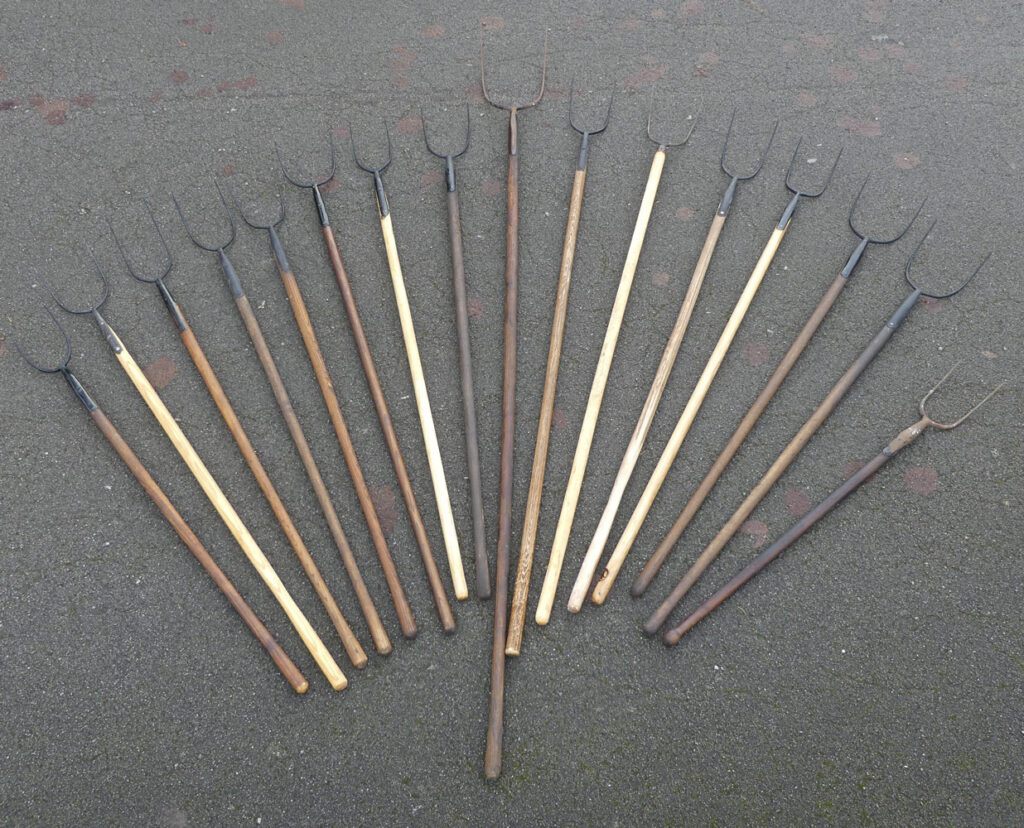
Hay rakes and pitchforks are the two most useful tools to have to hand once the work of your scythe is done.
Your scythe will have left you with satisfying windrows arranged in green lines across your meadow. You can take a moment to step back and admire your work, the efficiency of your scythe, and of a job well done. But very soon your thoughts must come back to the task you have just made for yourself: of dealing with all this cut grass and making hay, gathering it up and clearing it off the field.
As with the scythe, these specific tools have evolved over the centuries to help complete the task of haymaking as quickly and efficiently as possible.
Hay Rakes
Hay rakes are light-weight (as compared to metal rakes), they have wide heads to cover ground more quickly, and widely spaced tines/teeth so the grass does not get caught up in them too much.
The traditional pattern wooden hay rakes are still being made in Britain by Rudd’s Rakes near Appleby. They have a 78 cm (31 inch) wide head of 16 tines and a long 1.8 meter (6ft) shaft. They are constructed from ash with birch tines, and are very strong.
I have stock or these rakes for sale. Their price is £36 each. Due to courier issues (being over-sized), rakes are available by collection only from my scythe workshop, or on my courses.
Hay rakes are most useful for gathering up cut grass into windrows or piles. They are especially good for combing through the stubble to collect up the last loose bits of hay, or for gathering short cuttings from trimming a lawn. They can also be used to turn grass when haymaking.
Aside from grass they are handy in the garden for raking up autumn leaves, levelling gravel or sand (golfers use them in sand bunkers), and even levelling cultivated soil and combing out large stones.
Pitchforks
Pitchforks are indispensable tools for every stage of haymaking from the point where the scythe finishes to the haybarn.
Pitchforks can be used to spread out the new mown grass to dry, to regularly turn the hay and to fluff it up to get air into it to speed up drying. If rain threatens using a pitch fork is the quickest way to push the hay into temporary small piles (haycocks); and then to re-spread them when the sunshine returns. Pitchforks are an efficient tool for gathering in the hay: for flicking the hay in to windrows, for pushing up windrows into piles, and for pitching the hay up on to a cart or hay stack.
On the face of it a pitchfork is a very simple tool consisting of a long shaft ending in a two-pronged fork with long slender curved tines. It is perhaps surprising that it is so difficult to purchase a new pitchfork that is fully fit for purpose either in the UK or further abroad. All examples I have come across are poorly constructed with chunky round tines of inferior steel, crudely welded to the hafting socket leaving unfinished edges that catch on hay stems, and worse still some are so poorly balanced that the weight of grass on the fork wants to twist out of your hand back to the ground when you lift it.
The only answer I have found to this supply problem is to seek out vintage pitchforks from farm sales and tool auctions. Even examples that are a bit pitted with rust and need new handles are a better option than any you can buy new.