To work effectively a peening jig or anvil needs to be mounted in a solid support, and set at the correct height for comfortable working whilst seated.
On this page:
Folding Peening stools
Peening Logs
Tips on fitting a jig or anvil
Folding Peening Stool
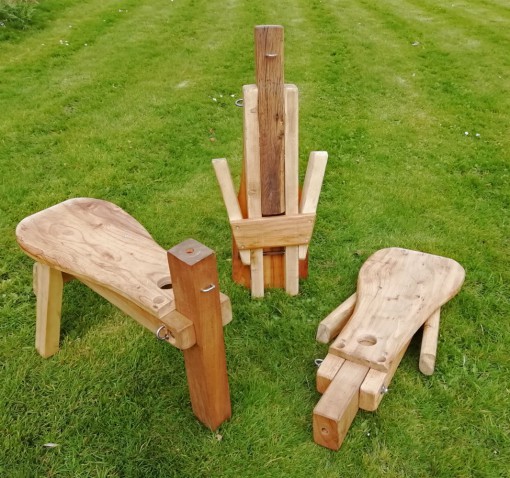
This folding peening stool is for mounting and supporting a peening jig or freehand peening anvil. Its integral seat and jig support means that you can maintain or repair scythe blades, whilst comfortably seated, in the correct position to support the blade across your knees during work.
Features:
Solid four-inch hardwood front anvil post.
Sturdy three-legged design with splayed rear legs for stability
Folding legs for ease of storage and carrying
Folds to lie flat in a car boot or to stand in the corner of a garden shed.
Wide seat to suit working comfortably in different positions (and useful as a stool for tea breaks!)
Tool rack for jig caps and hammer (to stop them falling on to the floor).
Hook for hanging whetstone holder
Available in two sizes: size 2 and size 3 (matched to snath sizes) to suit different leg lengths and knee height. Can be cut to bespoke fit user if required.
Weight 8-9 kilos
Dimensions (h x l x w)
Open: 50/55* x 70 x 40 (*front anvil post height size2/size 3)
Folded: 14 x 80/85* x 40 (*with size2/size 3)
*Sizes: size 2 and size 3 (matched to snath sizes) to suit different leg lengths and knee height: 50cm post = size 2; 55cm = size 3. Can be cut to bespoke fit user if required.
If ordering please specify your size preference.
Do contact me before ordering if you have any questions.
These peening stools are made by a craftsman and may vary as they made individually with different locally sourced woods as available.
All weight and dimensions given above are approximate and the appearance and colour of the wood may differ from those illustrated.
As the stools are hand built to order there may be a wait for delivery.
These folding stools are based on an original ‘open-source’ design by scythesman Michael Gerrard.
Peening Log
To work effectively a peening jig or anvil needs to be mounted in a solid support, and set at the correct height for comfortable working whilst seated.
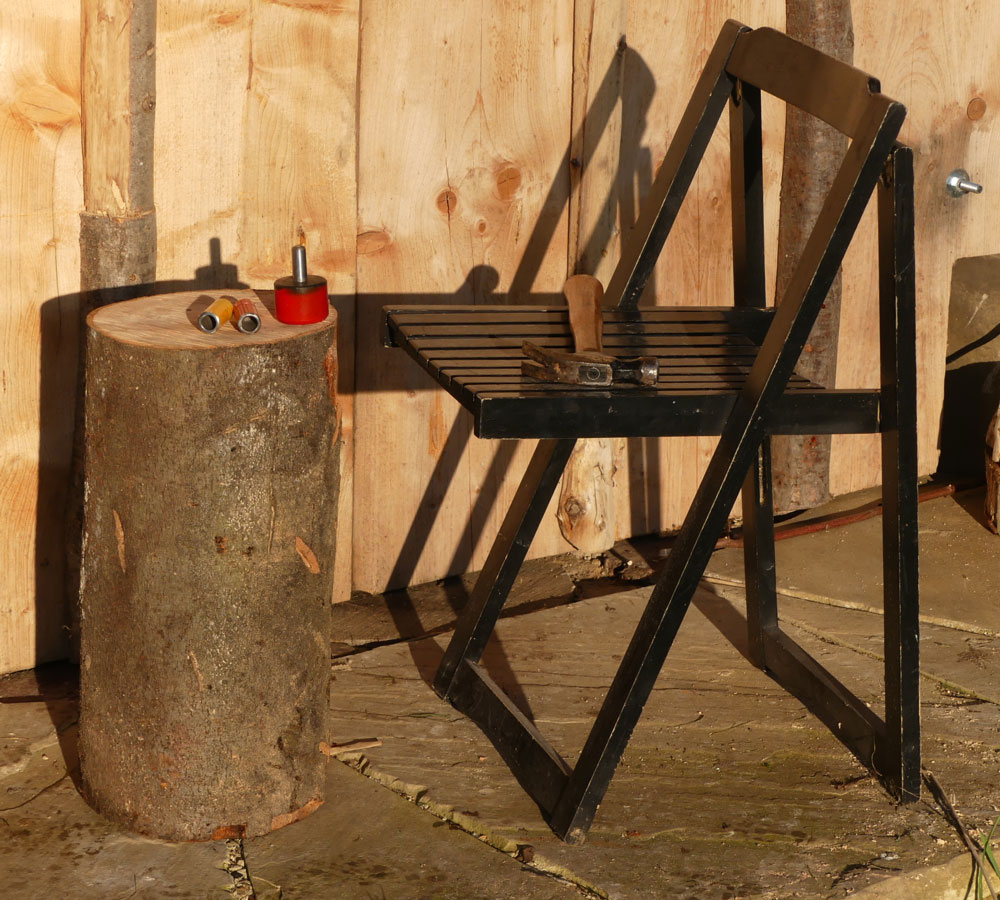
At its simplest this can be arranged by setting the jig in a sturdy log (typically 50-55cm tall) next to a chair of suitable height for comfortable working.
A heavy log (like the beech one pictured) is great for home use- the heavier and solid it is, the better it works -just not as portable as a peening stool.
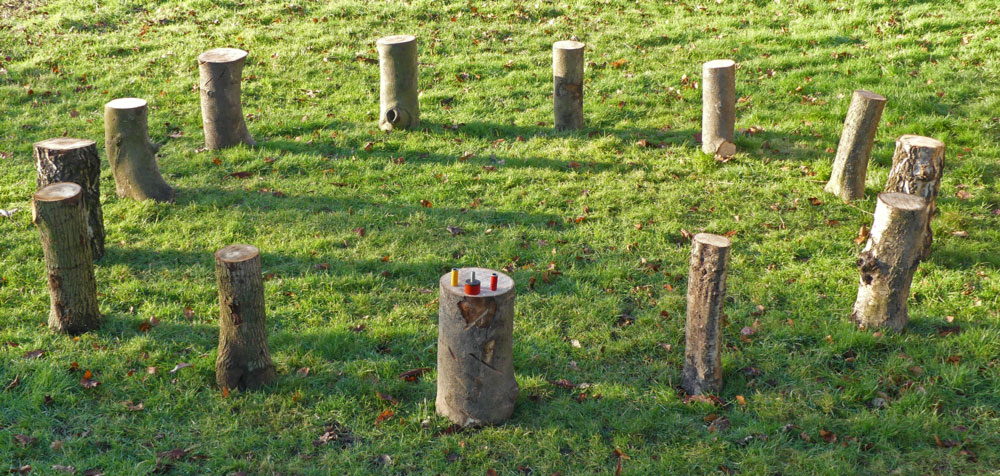
For visitors to my meadow and scythe workshop I do have a selection of pre-cut logs available – Price £10
Tips for fitting a jig or anvil
The front anvil post (or log) is predrilled with a 15mm hole tapered out slightly at the top.
The tapered spike of the jig needs to fit securely into this hole.
Do not hit the jig post or cap directly with your hammer as this will burr or damage the jig.
Use a wooden mallet or block of wood to gently settle it in place.
If it is a tight fit, it is better to file or drill out the hole a bit, as using too much force to drive it in may split the wood.
If the hole is too loose a fit, with some play, pack out the hole with slivers of wood or card. (Different Jigs and anvils vary in the dimensions of their spike; also, wood will swell and shrink depending on weather).
Using the jig to peen a blade will settle the jig into the post until the body of the jig sits on the post top. Using a hammer directly on the jig cap is OK once you have a blade in position to absorb the shock and prevent the two hardened jig surfaces clashing together.
To remove a jig: lift the jig and stool/log off the ground by the jig post, tap the side of the jig body with a hammer, the weight of the stool should be enough to separate the two. If not use a sturdy screw driver to prise it free.
When fitted the working base of the jig or anvil (on which the blade rests) should be level with the tops your knees whilst seated. This will mean you can support and position the length of the blade as you progress.
The height of the front post can be reduced if required to make it fit your knee height and working position. Simply mark cut a slice square from the top of the post. Do not cut too much – you can always cut it a bit shorter, but you can’t make it longer again! Redrill and file out the hole if needed.