
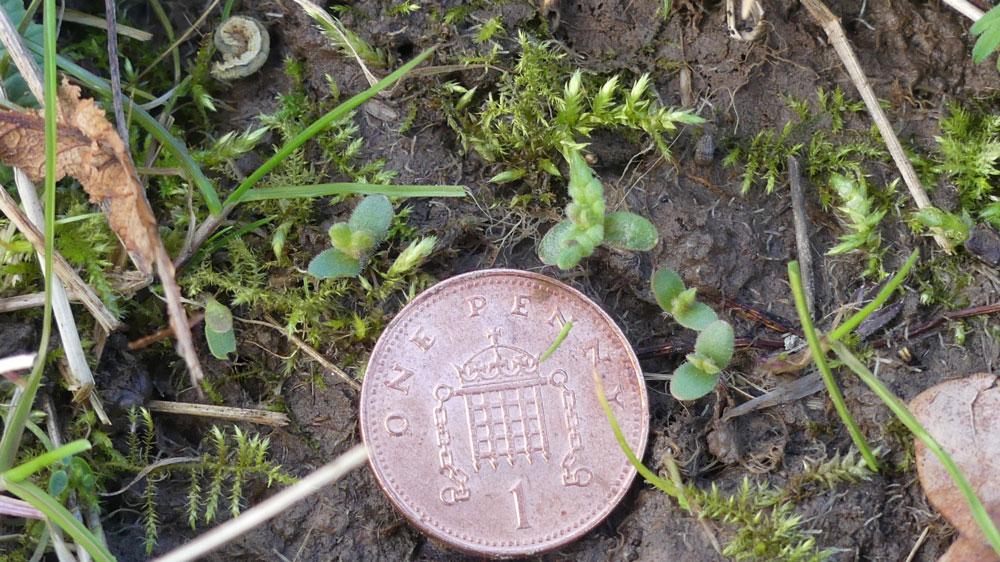
Yellow rattle emergence was first confirmed this spring in my Norfolk wild flower meadow on March 9th 2026.
The first emergence of yellow rattle varies from year to year. In my experience it corresponds well with other indicators of spring, such as the first appearance of bumblebee queens and frog-spawn. Looking back at my records over the last 15 years, the second week of March is typical for Eastern England.
Spring first arrives in the South of England and gradually moves northwards – apparently at about 4mph! It was recorded by scyther Mary Ellis in Kent about a week earlier, and in the North, on the 9th March, initial germination was observed (about a week before it would reach first true leaf stage).

What I record is the first seedlings with recognisable true leaves. Seed germination actually occurs a week or two before this, but their seed leaves are difficult to distinguish with certainty from other common meadow seedlings with rounded cotyledons such as buttercups.
Seeds that were either sown last autumn, or shaken from hay in summer, have spent the winter lying on the wet soil surface exposed to winter weather. Rather than being an endurance test, as one might imagine, this is just the stimulus yellow rattle seeds require: 3 to 4 months of prolonged chilling induces changes within the yellow rattle seeds that release them from their enforced dormancy. The seeds are thus primed and set to germinate at the first sign of spring as soon as the soil warms.
This synchronised early emergence of yellow rattle is critical. The seedlings must get a head start if they are to grab space before the surrounding spring flush of grass closes in and denies them light. In parts of my meadow the grass looks rather healthy and is likely to grow away strongly as soon as spring takes hold and potentially smother yellow rattle seedlings.
I will trim the meadow back in these sections to prevent the lush grass taking the light the young rattle seedlings need to be able to grow up through the sward. Meadows can be usefully trimmed in spring by light grazing or mowing in March and into April when needed. The yellow rattle will benefit from this provided you trim above the height of the developing young plants (less than 10mm now, rising to 75mm by April).
If successful, the young plants will soon attach themselves, via their roots, to nearby grasses and other plants to extract nutrients from them. Yellow rattle will flower in early summer and complete its life cycle when its seeds ‘rattle’ out to fall back to the ground in July.