
There really is no contest – the scythe wins on absolutely every criteria I can think of!
Even if I could think of one application a brush cutter or strimmer is better for than a scythe, I would still not want one as they are so horrible to use.
Scythes are faster!
On a purely practical level a competent scyther can expect to beat, or at least match the work rate of a brush cutter, and to mow to a higher and neater standard. I have proved this myself in a mow off challenge at the Somerset Green Scythe Fair against proficient and determined brush-cutter opponent.
Scythes go for longer!
Petrol brush cutters are exceedingly tiring to use – this to the extent that prolonged use causes a whole range of injuries and damage to the body and health of the operator. (see litany of hazards below). Vibration damage (white finger) alone frequently limits operators to being only able to operate the machine for a few hours each day.
There are no operational exposure limits for scything.


The choice of which way to work is surely a ‘no-brainer’!
Scythes are healthier!
If you pace yourself at a normal work rate (rather than a racing sprint) it is quite possible to comfortably mow all day – and be fitter at the end of it! With good posture and movement (training can help with this) scything is a very efficient healthy workout for all parts of the body – as well as getting the grass cut.
Scythes are better for animals and wildlife
High speed brush cutter blades and strimmer cords inflict very high casualty rates on wildlife from hedgehogs and small mammals to amphibians and insects. The casualty rate from scythes is very low (not quite zero) as most wildlife are able to get out of the way and avoid contact with the blade as it passes only once in a narrow slice though the grass under close supervision by the scyther.
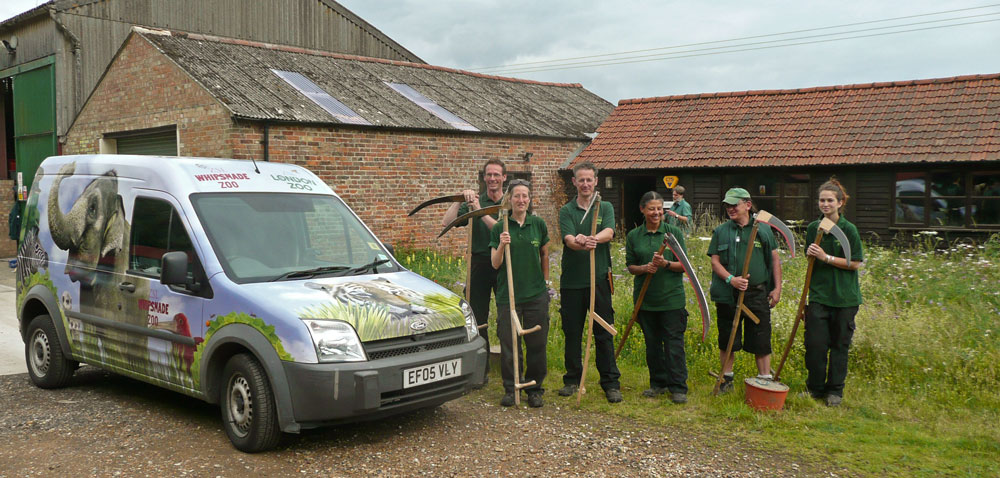
Just the noise of petrol engines can be distressing to some animals such as horses, even leading them to take flight and injure themselves. This can be particularly acute in confined spaces. London Zoo adopted scythes for tidying animal enclosures to eliminate this stress which had badly affected the anteaters in particular.
Scythes are better for the environment in general
Scythes = no fossil fuels, exhaust emissions or noise pollution. Minimal carbon footprint.
Scythes are kinder to neighbours and passers-by
With a scythe you can mow on a Sunday morning without disturbing the neighbours. In fact, in any situation mowing quietly with a scythe is more considerate of others enjoyment of say a pleasant summers day, or a peaceful country walk (which so often is spoilt by the firing up of many mower engines).
Quiet stealth mowing by scythe has been particularly appreciated in locations where peace and quiet is essential such as around doctors’ clinics, and academic institutions.
Other benefits
There are many other benefits that you will find that are uniquely associated with scythe use. Some of these can be found outlined here
The many hazards associated with brush-cutting machinery
| Operational Hazards | Brush cutters | Scythe |
| Moving parts – injuries | Yes | n/a |
| Kick back – injuries | Yes | n/a |
| Vibration – white finger | Yes | n/a |
| Noise – hearing loss | Yes | n/a |
| Weight – Musculo-skeletal damage | Yes | n/a |
| Fuel and fumes -COSHH | Yes | n/a |
| Flying debris | Yes1 | n/a |
| Biohazards | Yes | Yes2 |
| Wasps and bees | Yes | Yes3 |
Hazard note 1: Flying objects
Flying objects, such a stone fragments kicked out by high revolutions of a brush-cutter, are a serious, costly and dangerous hazard. People have lost eyes and sustained other injuries from this. More commonplace is the damage to windows in cars and buildings from brush cutters and other grass cutting machines. This is simply not an issue with a scythe.
Hazard note 2: Biohazards
With a scythe there is a much greater chance of spotting biohazards and no risk of spattering them and making them biohazardous flying debris (as happens with strimmers and brush cutters).
Dog poo is the most common and unpleasant biohazard frequently encountered on public sites as most professional brush-cutter operators will testify – and worse, full PPE is not always enough protection from the excremental spatter – even managing to bypass face visors and enter the mouth – Yuk!

Hazard note 3: Wasps and Bees.
Wasps and Bees are both aggravated by noise and vibration, particularly from petrol engines and will attack and sting intruders. The greater the intrusion the more aggressive the response.
There is a much reduced risk when working quietly with a scythe but be alert as footfall vibrations close to a nest can still attract their attention.
| Operational safety requirements | Brush cutters | Scythes |
| Safe working distance | minimum 15 metres | 2 metres |
| Clean and maintained equipment | Yes | Yes |
| Site warning signs | Yes | optional1 |
| Hi-vis clothing | Yes | optional2 |
| Training | Yes | Yes3 |
| Proficiency certificate | Yes – legal requirement4 | n/a4 |
| PPE required | Brush cutters | Scythes |
| Helmet & visor | Yes | n/a |
| Face/eye protection | Yes | n/a |
| Ear defenders | Yes | n/a |
| Non snag clothing | Yes | n/a |
| Safety footwear | Yes | optional5 |
| Gloves | Yes | optional6 |
Safety footnote 1: Site warning signs
When scything in areas with public access signage may sometimes be advisable to keep curious public and dog walkers at bay.
Safety footnote 2: Hi-vis clothing
A requirement for brush cutter operators in public spaces to warn others of the hazard. When scything in vulnerable situations, such as road verges, wearing hi-vis is recommended for personal protection.
Safety footnote 3: Training
Some training in the correct and safe use of the scythe is recommended, particularly to get all the benefits of its use.
Safety footnote 4: Proficiency certificate
For brush cutters the passing of a NPTC accredited proficiency practical and theory test is a legal requirement for operating a brush-cutter in a professional capacity or on public land. The absence of a certificate is also likely to invalidate an operators insurance cover.
The relative low risks associated with mowing with a scythe means that scythe operators do not need to be tested and certificated. The only instance where a scythe training certificate is of use is for CPD records.
Safety footnote 5: Safety footwear
Safety boots are not needed to protect the feet from ones scythe. Sensible footwear is only needed to match any hazards that might be found on the ground. On verges and other public spaces with a possibility of broken glass hidden in the grass strong shoes or safety boots would be appropriate. On a soft lawn or meadow mowing barefoot is quite in order.
Safety footnote 6: Safety Gloves
99% of scythers choose not to wear any gloves, preferring dexterity and control over the low level risk that they might get a minor cut whilst handling or sharpening the blade.
People with soft hands and a risk of blisters sometimes find it more comfortable to wear gloves whilst mowing. Some people with anxiety about sharp edges are reassured if they wear gloves.
If you opt to wear gloves for scything I would recommend lightweight gloves for comfort and dexterity that are rated for high level of cut resistance.