
My investigations and review of whetstones in 2023 led me to having to get to grips with the concepts of material hardness and its measurement. It is a concept with useful relevance to whetstones as well as blade steel and peening equipment. In the following article I share my findings for anyone interested in diving deeper.
Whetstones
For the rock and minerals that make whetstones the Mohs hardness test is simple to apply and easily understood. Because of its simplicity it is widely used by both school children and by gemstone specialists.
The Mohs test is a scratch test: it is based on comparing whether one substance is hard enough to scratch or mark another, and by this assessment ranking different material on a relative scale, with diamond being the hardest at Mohs 10; quartz 7 and steel c.5.
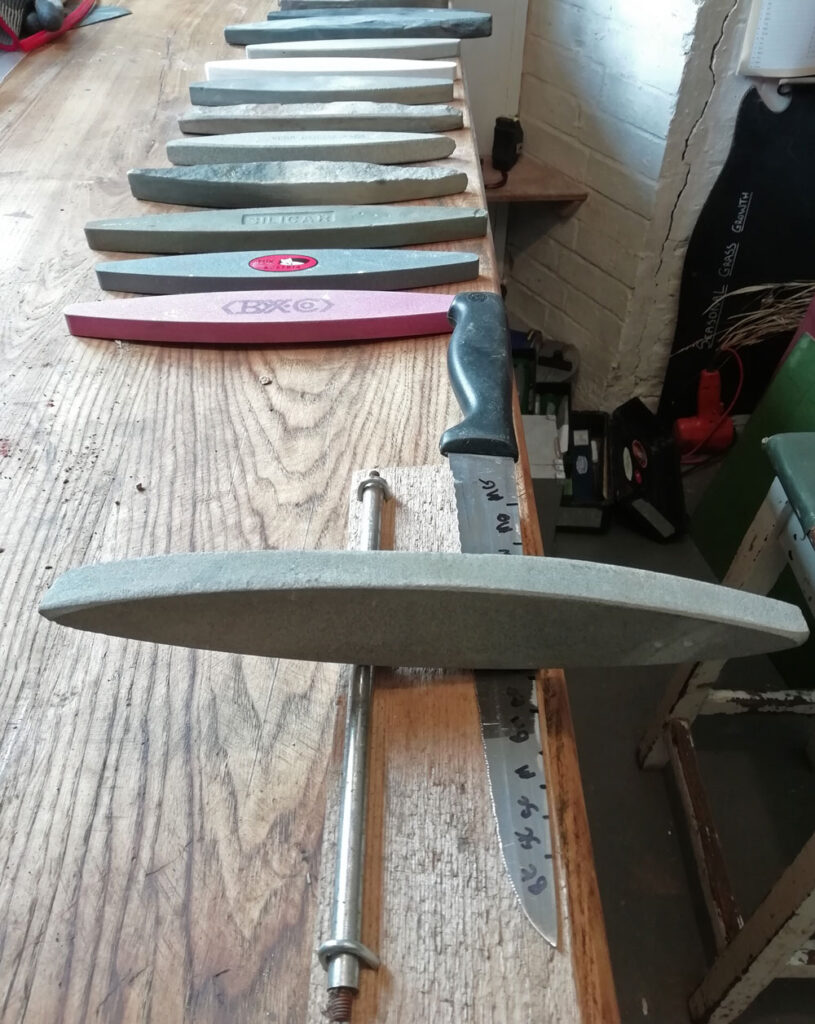
From the whetstone perspective this Mohs scale is useful and relatable as it essentially what we are interested in as to whether a mineral based stone is hard enough to efficiently abrade and sharpen a steel blade (Mohs c. 5). The Mohs hardness of minerals is easy to look up, and the hardness of steel fairly predictable at least within the scope of this basic assessment.
The limitation of the Mohs scale is that the differences between the points along the scale are not uniform and linear, and secondly it is too coarse to discriminate at the finer scale, say between different grades of steel.
Steel and other metals
For grades of steel the more useful test is the Rockwell Hardness scale. This is way more technical in concept and application requiring expensive scientific equipment to assess. In fact there is not just one test, but a set of Rockwell methods and scales depending on the material and hardness. For blade steel the Rockwell Hardness C (RHC) test is most appropriate. For mild steel and copper alloys like Bronze: Rockwell B (RHB).
Mohs values versus Rockwell values.
Technically as the underlying test methods and principles are very different; they measure different characteristics of hardness. This means these two hardness scales are not readily comparable (I found it quite difficult to find many websites willing to even attempt this). Having worked with the scratch-test version for the RHC scale, within the specific narrow range we are interested in for blade steel, it is just about possible to see an approximate relationship with RH. RHC values have roughly ten times the value and resolution of the Mohs value: Mohs 4.5 – 6 equivalent to RHC 45 – 64.

Testing scythe blades
Even with the right equipment, testing the RHC hardness of a scythe blade is not a simple undertaking. The RHC test method ideally requires the test material to be smooth, flat and uniform.
Testing the work hardened hardness of a tapering blade edge before and after peening for example is a difficult technical challenge. Even without peening, hardness is likely to vary within a blade as a result of the forging, hardening and tempering processes which alter hardness differentially across the blade. This even given the fact that blades start out as a bar of uniform modern steel produced to a very high and consistent standard of quality and carbon content. This was far from the case in the past for blades and weapons of antiquity. For example, assessing a mediaeval sword, some 20 sample points from different parts of the blade may have to be measured to get a good overview of its hardness characteristics. http://myarmoury.com/feature_bladehardness.html

Fortunately there is an alternative simple method for roughly assessing the RHC hardness often used by knife makers which makes use of graded set of hardness files each of a known RHC. This is a scratch test essentially using exactly the principle as the Mohs test. The file test is most useful in making general comparisons rather than generating a specific number as there are many variables that effect the results including the consistency with which the human tester applies each file. Following advice from Benjamin Bouchard of Baryonx knives I purchased a set of these files made in Japan under the name Tsubosan. With these I can roughly assess the relative hardness of different blades.
Hard or soft steel which is best?
Softer steels fall in the 40-55 HRC range. These require sharpening more often, but they are much easier to sharpen than harder steels. They are also less likely to chip. The edge is more likely to roll over, rather than chip or crack, which is a much easier fix.
High impact blades like axes, machetes and larger bush craft knives most often use a softer steel. These blades are put to harder use than smaller everyday pocket knives, and must be able to take a lot of brute force without breaking or chipping.
Medium steels. Pocket knives and regular kitchen knives will typically fall in the mid-range hardness of 56-60 HRC. They will hold an edge reasonably well and are not difficult to sharpen. The famous Victorinox ‘Swiss Army Knife’ stainless steel blades have a HRC of 56; and Opinel knives 57-59 HRC.
Hard ‘premium’ steels in the range 59-66 RHC by contrast are capable of holding a very fine thin sharp edge that will cut without going blunt for much longer than a softer steel. The trade-off is that the edge is more brittle and vulnerable to damage. They are much harder to repair and sharpen, they need ceramic or diamond hones to make any impression and are beyond the capabilities of most natural stones. Super-premium Japanese steel blades have to be used with great care and respect so as not to damage them.
Choosing the right hardness of steel is always balancing act. The idea of better edge retention that harder steel can bring, with less honing and less peening is tempting. With the availability of advanced harder steels many modern tools from ‘stay sharp’ kitchen knives to hard point saws have gone that way. There is always a downside to this such as saws that are ‘disposable’ as they are too hard to sharpen.
Hardness of Scythe blades
Austrian and other European tensioned scythe blades are forged from a softer steel. I assessed my Schrockenfux blades with the Tsubosan files as having a HRC iro 40-45. Their steel is soft and malleable so that it can be cold-forged to reprofile the edge by peening with a hammer. They are quick and easy to sharpen but do need frequent honing as they do not hold their edge as well as hard steel. Being softer they are less likely to crack or chip on impact with obstacles or tough material, and any damage sustained is relatively easy to repair.

There are noticeable differences between manufacturers and blade models in this regard. I have experience of some Italian Falci blades which I have found prone to deeper cracking or even splitting when damaged rather than minor tears and the edge folding back (as usually the case with softer blades). My Tsubosan file test showed that indeed these Falci blades are produced with a significantly harder finished steel with an HRC iro 50+.
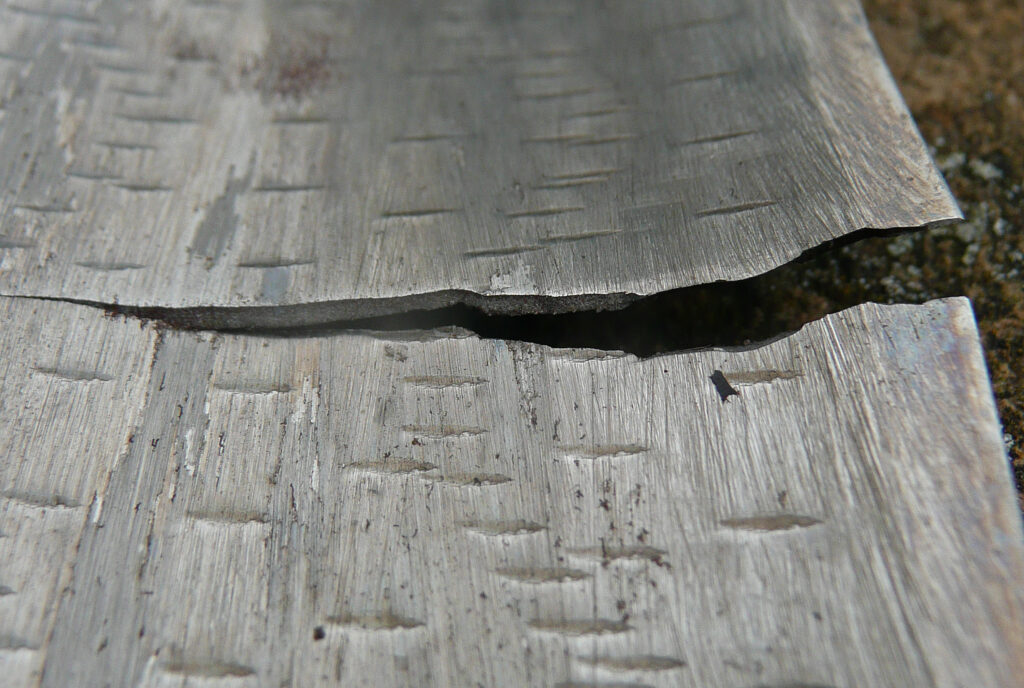
It is suggested that these more fragile Falci blades are perhaps best reserved for light duty tasks in soft lawns and meadows lacking, stones, fallen twigs, tough weeds, tree suckers and the other commonplace obstacles and debris. (ie used with care like Japanese knives).
Schroeckenfux offer a ‘Hartstahl’ range. These blades are finished to a greater hardness during final hardening and tempering. Fux say that being harder means they are more brittle and have less tenacity/toughness (german Zähigkeit). They take more effort in peening and the stability of the cutting edge is dependent on how they are peened. Comparing these to regular Schrokenfux blades indicated that they were not really significantly harder. I could feel the difference with the Tsubosan files (slightly less bite) but with a difference of less than 5 points RHC: not enough to put a figure on it.
Arti blades made in Russia have a different production process and have been reported to be of a harder grade of steel so more difficult to peen. I don’t have an Arti to test myself, but do not remember them being difficult to peen when in Romania. They were perhaps a bit prone to micro cracking – but that may be just the workaday way they peen in Romania (quick but effective).

I have a Gunas blade made in Turkey, it tested as HRC 50. It was more difficult to peen but mainly as they do not come out of the factory well finished.
Peening and work-hardening effects on Hardness
Peening the very edge of the blade work-hardens the cutting edge zone so it can hold a finer edge.
Hardening in the context of work-hardening however does not simply involve increasing the hardness value or resistance to scratching (abrasion). In fact the measurable increase in hardness after peening is small, a few points on the RHC scale and so below the resolution of the Tsubosan files. I could feel the difference with the Tsubosan files (slightly less bite) but with a difference of less than 5 points RHC not enough to quantify.
Work-hardening by peening importantly makes the steel more resistant to plastic deformation. The crystal arrangement within the steel is consolidated making it stiffer and more resilient. A work-hardened fine edge is less prone to rolling (which would functionally make the edge blunt). On this basis softer Austrian blades really do need peening to hold an edge. If however the edge is over-peened it can become stressed to the point where it becomes brittle and cracks appear.
Work hardening the edge potentially makes it a bit more vulnerable to impact damage, but as the work hardening only affects the last few millimetres of metal any damage is usually superficial and so again is easily repaired (even in the case of over-peening).
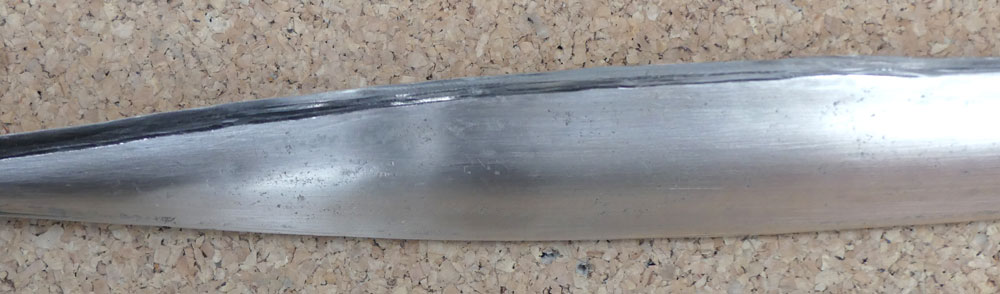
Bronze is an even softer metal (Mohs 3). Without work-hardening by peening bronze age tools have no hope of holding an edge.
Grinding blades
English scythe blades are generally made from a harder grade steel so are too brittle to withstand peening. These need to be ground on a grindstone to reprofile the bevel.
Being of harder steel they hold their edge for longer and need less frequent honing. They are typically honed with coarser more aggressive whetstones as needed to make an impact on the more resistant steel. They are potentially more prone to cracking or even breaking but this risk is partially offset by their blades being thicker and heavier than the equivalent European blades.
Patent rivetted English blades are the hardest with the body stamped from uniformly hard sheet steel riveted to a supporting rib and tang of softer mild steel. I assessed these blades as having a HRC iro 50. I have tried drilling patent blades for grass nails – tricky (particularly a Mountford blade with a HRC 55+) even with high-speed cobalt tipped bits!
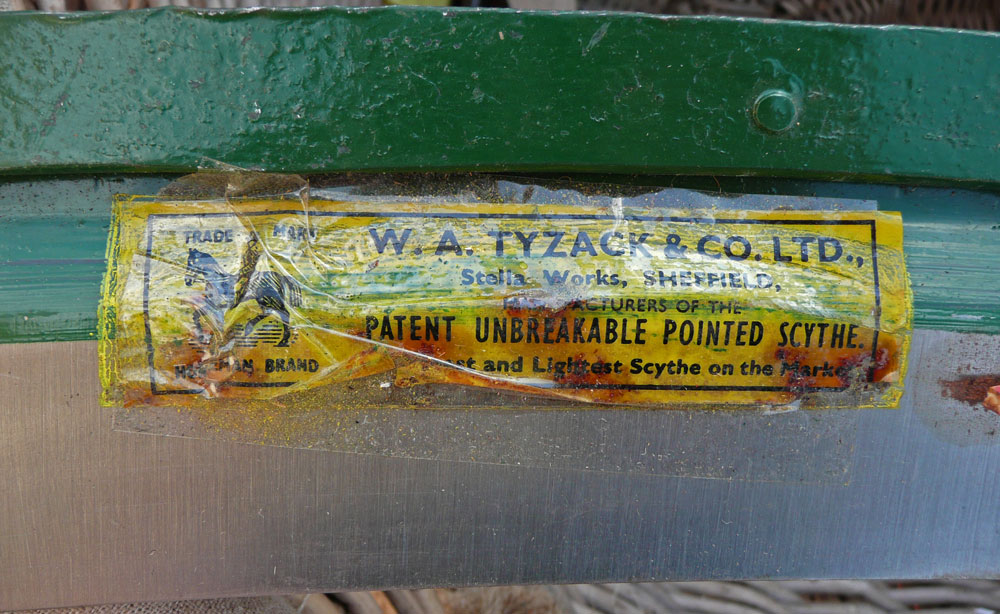
These blades were sometimes marketed as “unbreakable”, a sales attempt to reassure against their reputation for snapping, particularly the blade tips on impact with an obstacle..
Forged English ‘Crown blades’ have a more complex construction, are more resilient but were more expensive. They are a laminated sandwich of steel with an inner core of hard steel and an outer cover of softer steel. The harder thin steel core is able to “carry a superlative cutting edge” but is more brittle so needs the support of the softer more malleable outer layers. When honed the softer steel covering is readily removed to expose the thin cutting-edge core. These blades will not withstand peening (the core is not malleable and will crack) so the edge profile must be ground. Testing crown blades was tricky, but they seemed have an outer HRC 40+ and the exposed harder steel cutting edge 50+.
Crown blades represents an attempt to have in the blade the best qualities of both types of steel. Swedish Mora knives are another example of laminated steel blades using very hard (HRC 61) carbon steel laminated between softer alloyed steel
Peening Jigs and anvils
These need to be case hardened like a hammer’s head to resist deformation in use, ideally HRC 55-60.
The Austrian (Schrokenfux) and Slovak made jigs tested suggested an HRC of 50+. Some Czech made jigs however were much softer only HRC 40. The latter explains why there have been some issues with these jigs deforming in use. At 40 they are potentially softer than the blades being peened; especially Falci blades.
Picard anvils and hammer faces also tested HRC 50+
Your observation about the limitations of the Mohs scale compared to the Rockwell hardness scale is quite insightful. It’s true that while the Mohs test is user-friendly, it lacks the precision needed for assessing modern blade steels accurately. In practical use, I’ve found that variances across the blade can indeed complicate getting a reliable hardness measurement—especially with forged blades. How do you recommend dealing with these inconsistencies when testing or comparing different blades?
I am afraid my post lays out the extent of my knowledge and understanding on the topic of hardness. What can be achieved and an amateur without highly sophisticated technical equipment and knowledge is somewhat limited.