
Ants are a key, but often hidden, component of the ecology of healthy grassland. However, their propensity to form large mounds is not welcomed when scything as the soil they are built from blunts the blade with every contact, and mowing around them is awkward.
In this article I deep dive into both the ecology of ants in grassland and management strategies to work with and around them with a scythe.
The two main mound building species you are likely to encounter and curse in your grassland are the Yellow Meadow Ant (Lasius flavus) and the. Black Ant (Lasius niger). It is their mounds that you will notice as these insects spend most of their time out of sight.
Both nest in the soil and may build mounds. Black ants disperse and forage above ground, yellow meadow ants forage underground feeding off root aphids. Btw neither species sting (like red ants).
Yellow Meadow Ant (Lasius flavus)
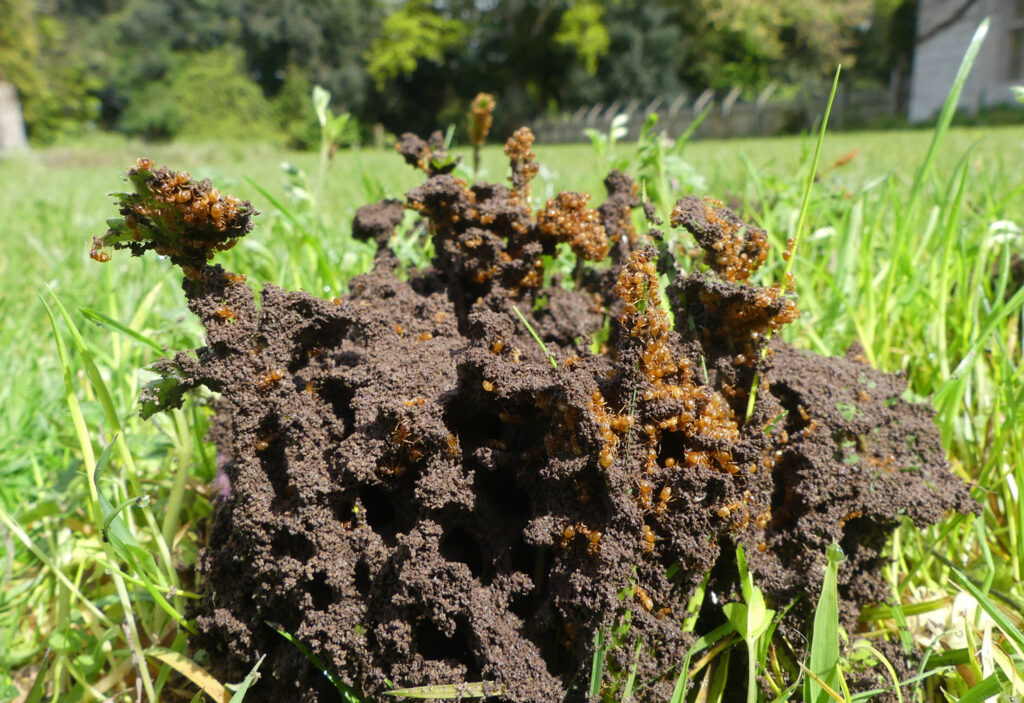
Yellow meadow ants making a bid to build a mound in my front lawn (utilising the shelter of an upturned bucket I had left out).
Dr. Tim King (1) calls these ‘keystone species’ like beavers for their transformative role in ecosystems – in this case grassland. They largely live underground in extensive networks of tunnels where they ‘farm’ root aphids: they ‘milk’ them for honey dew. Like farmers they collect and bring these aphids in to the mound to protect them overwinter and then put them back out to ‘graze’ in spring. In spite of being called ‘meadow’ ants they are not present in my meadow. They actually thrive in my lawn where there is no chance of building a mound above ground. Mowing it seems is not necessarily an impediment to Yellow meadow ants.
Black Ant (Lasius niger)
Black Ants (Lasius niger) are very adaptable and so found in almost any dry and open area where the ground is warmed by the sun. Its large colonies thrive in parks, gardens, roadside verges, pavements, coastal areas and brownfield sites hence its full common name ‘common black garden ant’.
Black Garden Ants also ‘farm’ aphids for their honeydew, but on aerial shoots above ground. These aphids gain some protection from predators in return. Black Garden Ants are fantastic soil engineers. They can build temporary seasonal mounds in summer when the ground is not dry or warm enough.
Grassland Ant ecology:
What they like and why do they build mounds?
These ants need warm dryish, but not desiccated or compacted soils. This is especially critical for nesting and successful brood rearing in summer.
Open, short tightly grazed grassland swards (turf) is generally beneficial for ants. The key factor here being that the soil is warmer with a reduced shading effect from vegetation cover.
Soil temperatures shaded by tall growth in meadows are generally too cool for ants in summer. This is also true beneath unrestricted tall grassland tussocks and mats (ie that is not mown or grazed) or in the shade of trees and shrubs.
Mound forming ants (yellow and black) in the open can engineer a solution to cool damp soil by building free draining mounds that warm in the sun.
Black ants regularly build ephemeral mounds in seasonally cut meadows with taller vegetation; especially in cool damp summers.
Yellow ants however will build perennial mounds that be very long-lived. These ants are prevented from building their perennial mounds to any size in meadows as they are regularly knocked flat by mowing, harrowing and rolling. Their mounds can only naturally develop to their full potential size in livestock-grazed grassland.
Grassland habitat selection by ants
I have been lucky to observe good populations of both black and yellow ants in my own garden. Interestingly the two species do not favour the same grassy places, and their choice is not what I expected. This is what led me to question their differing preferences in more depth.
I have black ants in my meadow who will build temporary mounds in a cool wet summer (but not in a dry summer).
However, I do not have any Yellow meadow ants in my meadow but do have thriving colonies in my front lawn which are regularly visited by green woodpeckers as a result. I do not see black ants here.
This clear observation has even led me to question the name attribution of meadow to the yellow ant. (those who know me will know my feelings on the correct understanding of the term meadow!). And also, to wonder about the popular idea that yellow meadow ants will not tolerate mowing (that is the defining criteria of meadow grassland).
What is going on? For functional clarity of meaning I will drop the meadow bit and just talk about Yellow ants from here on
Lawns – yellow ants
My front lawn is regularly mown, (weekly from March to October as needed, except for a short break midsummer), so yellow ant mound formation here is impossible. Despite this I do have a thriving yellow ant population in my lawn.
I do not know how many colonies I have, but I think they cover most of this sunny lawn area. In summer as when I relax mowing to allow some low-level flowering, a number of proto-mounds appear between cuts.
From this I deduce that mowing per se is not the primary factor limiting yellow ant colonisation; it is more likely to be sward height and the resulting effect vegetation shading has on soil temperatures. This lawn is ancient (c.500 years+) my soil is a silt loam, fine textured, drains well and is a warm soil. It must provide everything the ants need for the majority of their extensive subterranean activities.
The restriction to mound formation from regular mowing must be secondary as my yellow ants seem to manage underground without constructing mounds. On my soil the yellow ants “choose” the frequently mown lawn over all other grassland types. This even although my managed meadow grassland is available to them right next to my lawn and is of the same age and soil type.
Pasture – yellow ants
Pasture is where yellow ants and their mound building most noticeably thrives.Pasture, be clear, is grassland which is year-round grazed with livestock, (not a meadow, which to emphasise once again, is specifically grassland cut for hay annually and closed to grazing allowing it to grow up to full height over the peak growth season).
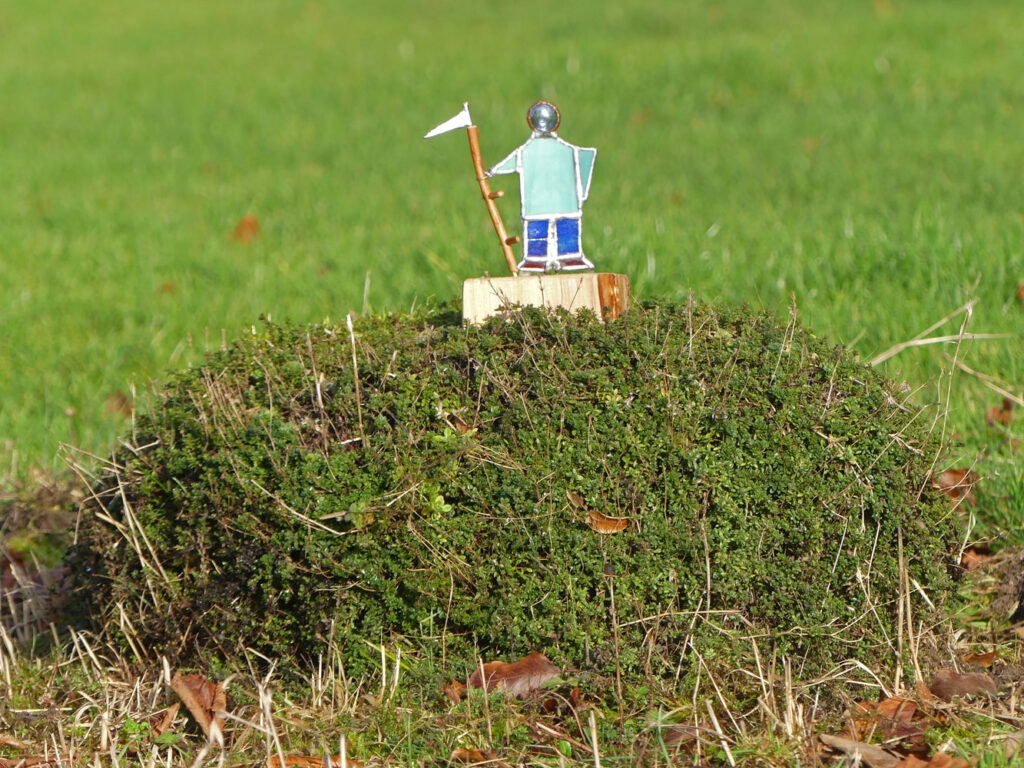
Grazed pasture is ideal habitat for yellow ants, especially the tight short sheep grazed variety found on downland and in parkland. The short vegetation growth here allows the sun to warm and dry the soil surface. Regular and continuous grazing also suppresses tall rank plants in favour of low growing species. In this circumstance the yellow ant mounds can build over years and decades into impressive structures, beautifully trimmed by topiary sheep. Here the mounds can even develop their own plant communities distinct from the surrounding level soil.
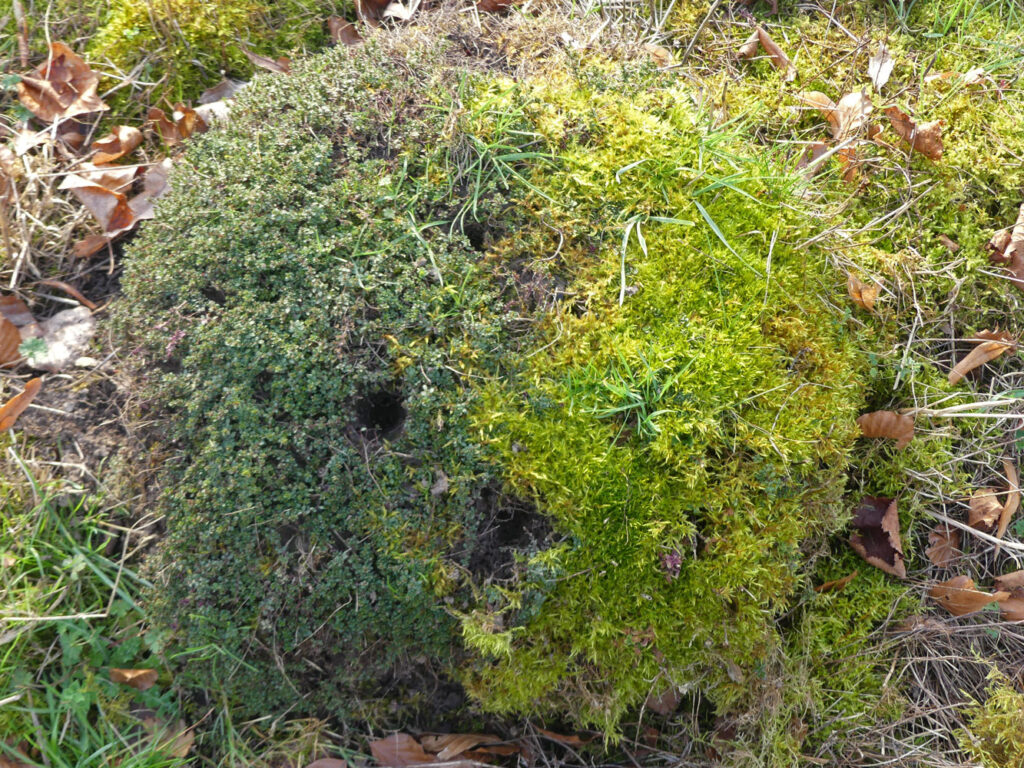
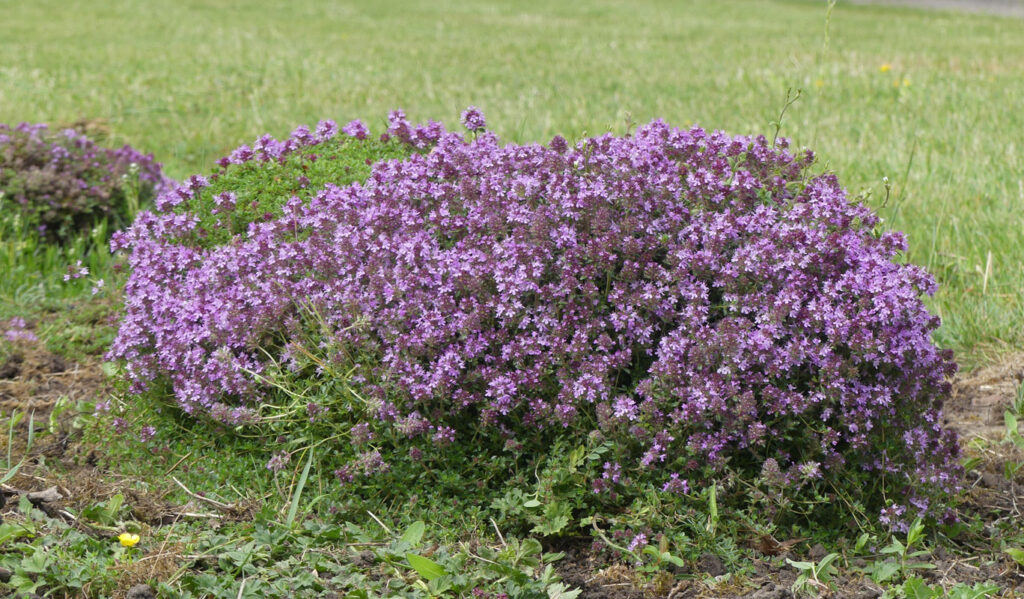
Perennial yellow ant mounds can develop their own unique micro habitats. The mound in the photo above is a yellow ant mound I have allowed ants to build over a number of years on the edge of my lawn. It has wild thyme (a classic ant mound species) covering its warm south facing side and moss on its north face. It is also pock marked with holes from the attentions of green woodpeckers.
Meadows – black ants
Whilst yellow ants seem not to colonise my meadow, Black ants on the other hand seem to manage Ok. If things are too damp and cool, they are able to very quickly build temporary mounds.
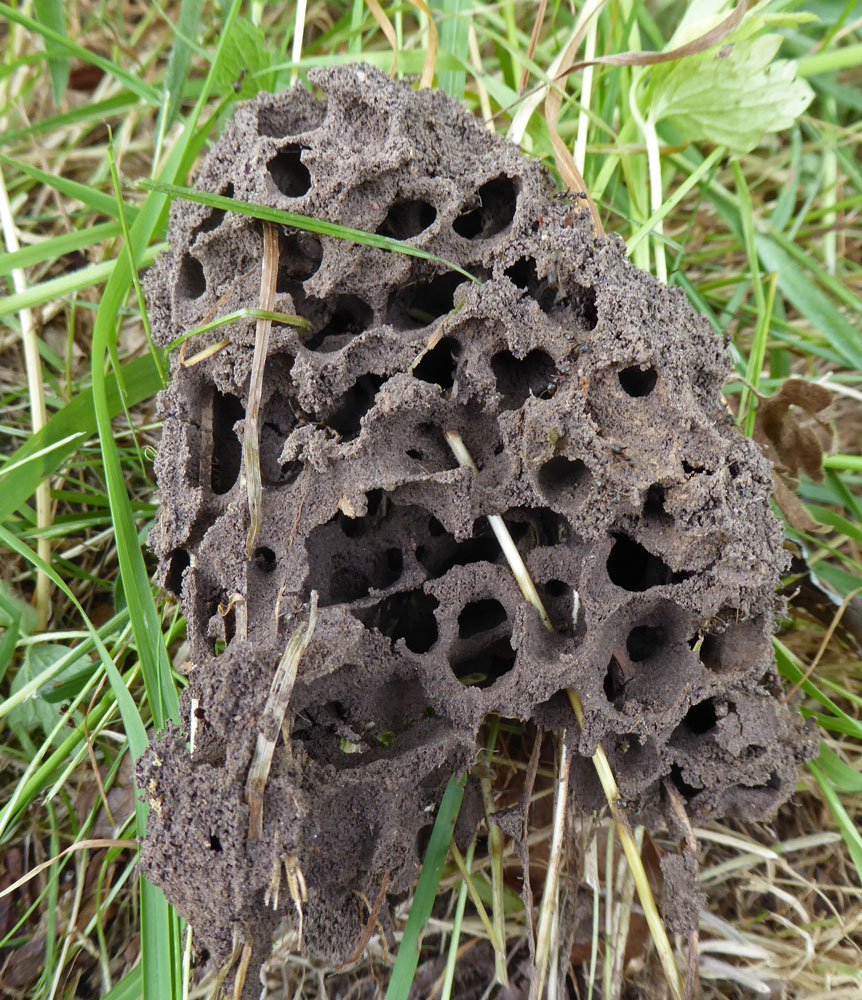
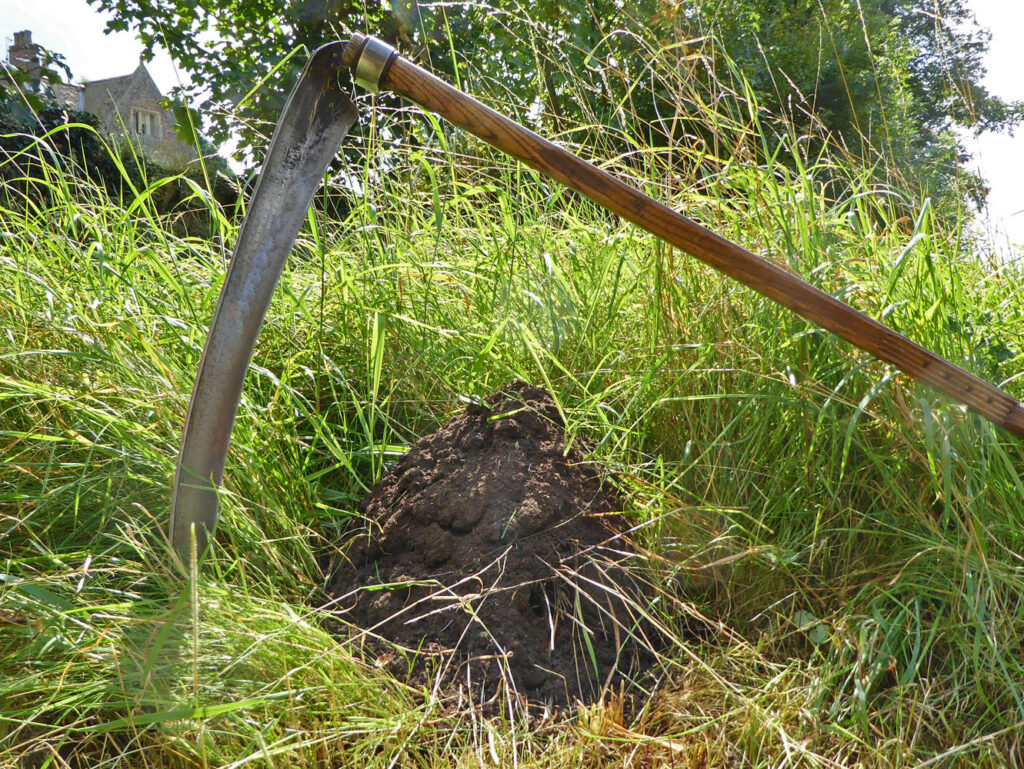
The black ant mound pictured above was cut through with a scythe blade. These mounds are often tall and columnar in shape using stiff meadow grass stems as scaffolding. They remind me of mini termite mounds. These mounds are fragile and ephemeral. Provided they persist long enough through one summer for the colony to rear their broods, the job is done. After this the mounds either get flattened by mowing and harrowing or simply collapse and melt away with rain, the ants having relocated back below ground.
Management advice
Ant pastures and lawns
Larger grassland pastures with old well-established and ancient ant mounds really should continue to be maintained as short turf by tight grazing whenever possible, as I am sure you would agree.
Yellow ants, as I have described, seem to do well in my old lawn, as do waxcap fungi. Again, my management strategy will mainly be to maintain the long-established status quo. I do arrange a short pause in mowing in June to allow white clover and selfheal to bloom at a reduced height. cutting back again before the growth accumulates enough to shade the soil. I have also permitted yellow ant mound building within a wild thyme lawn I created in the centre of the main lawn.
In gardens, and perhaps small churchyards, grazing can be replaced with simulated grazing: mound topiary – trimming with shears, sickles, or nimble use of a scythe (which members of our scythe community report as successful). I hand weed my ant mounds to pull out invading tall grasses like cocksfoot and tall oat-grass. Trimming and weeding is only practical and sustainable on a small scale.
Conversion of pasture to flowering meadow
If a land owner is determined to let former pasture grow up meadow style to flower the best way to manage this is again with livestock. The pasture should be shut up (livestock removed) from April/May until July. Then, instead of mowing with machinery put the livestock back to eat the standing crop. This cycle produces a plant community very close to mown meadows. It may not be ideal for ants as there will be a period of shading during June/July, but better than levelling the soil by mowing and harrowing.
Meadows
Meadows do not seem to suit yellow ants, but black ants can thrive.
Knowing black ant mounds are temporary when I come across them mowing I either mow around them if they are fresh and active. If not, I knock them down and spread the soil whilst mowing or later.
Abandoned, Neglected or rewilded rank tussocky Grassland
Mound forming black, and especially yellow, ants do not thrive in tall overgrown vegetation as described above.
A change in management of land with old established yellow ant populations and mounds can quickly have a negative effect on the ants.
Yellow ants with pre-existing well developed mounds can hang on for some time in abandoned grassland (unmanaged, not cut or grazed) if the mounds are tall enough to project above the vegetation. In time however abandoned grassland will be taken over by rank tall grass, scrub and woodland. The ants will have to move or die out.
Generally
The meadow mowsaic principle of applying different linked mowing strategies within a site will deliver the best most biodiverse results overall.
For yellow ants this means having some areas grazed or trimmed so they can thrive and build mounds, adjacent to seasonally cut meadow and other habitat. In some meadows I have visited ant mounds have developed or been ‘encouraged’ along the boundaries and fence lines of mown grassland. Sometimes, as on Transylvania, even forming up in lines which can serve as boundary markers in the absence of fences. From these brood mounds the yellow ants foraging tunnel network can reach some distance to utilise the adjacent meadow.