
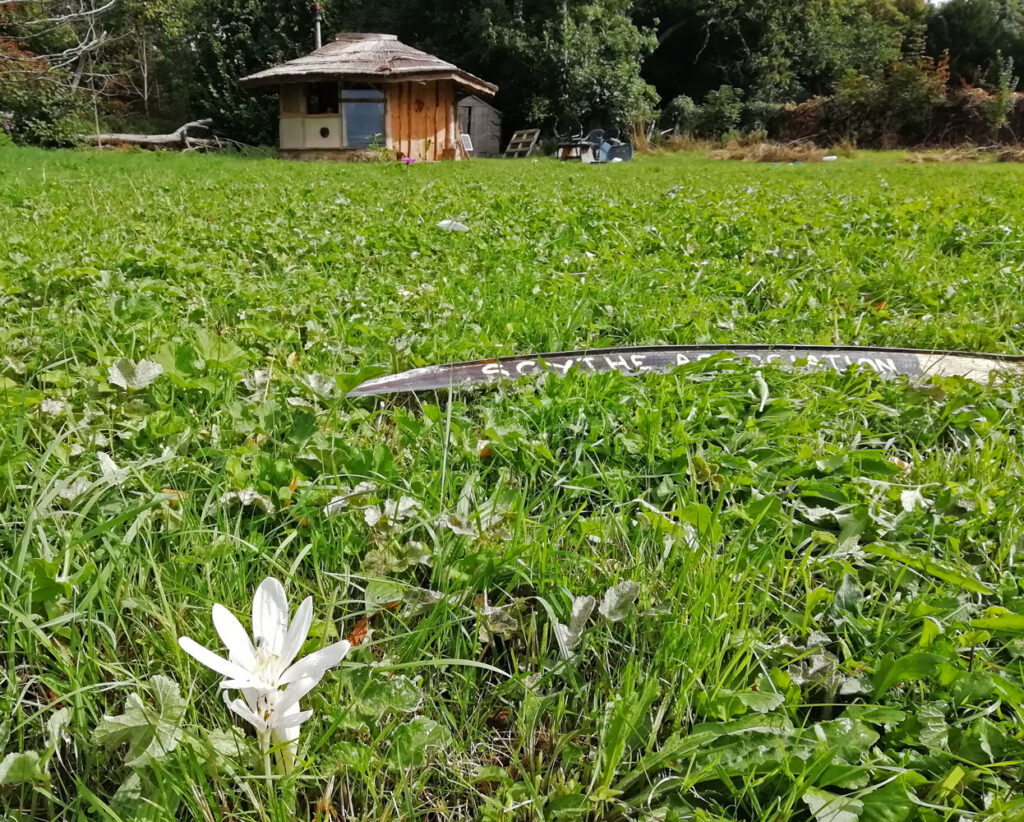
Autumn is still a busy time in the meadow and grassland calendar. The much needed autumn rain has given fresh green life to my meadow so there is mowing of the aftermath regrowth to be done.
Aftermath mowing with a scythe
Autumn mowing helps restore balance in meadow plant communities. After the main summer hay cut studies have shown that the late summer/autumn aftermath management has the next biggest influence on the long-term structure and diversity of the sward.
Aftermath refers to the second crop of grass that regrows after the main summer hay cut has been removed. The ‘math’ in ‘aftermath’ has its roots in the Anglo-Saxon word maeth, which means ‘a mowing’ (Math is also like "Mahd" in German where it is the noun of "mowing"). Many words like meadow and mead are similarly derived from words relating to mowing. Aftermath then is the second mowing (grass harvest) after the main midsummer hay harvest. In Britain second cuts, ie mowing the aftermath, are rare. The aftermath regrowth is almost exclusively utilised directly by grazing with livestock in the field as ‘aftermath grazing’.
Like many meadow owners I do not have livestock to graze the aftermath. The aftermath regrowth can be mown with a scythe and collected. Depending on weather, I mow a number of times through autumn aiming to do a final cut at the end of October leaving the sward short (c.50- 70mm) going into winter.
Lax mowing and topping. In my own meadow my focus in recent years has been to apply selective lax mowing with the aim of suppressing tall competitive herbs such as hogweed and knapweed, whilst at the same time encouraging lower growing less competitive plants. In practice what this involves is topping the sward as it regrows. I say ‘lax’ mowing as I want to maintain a healthy ground over of diverse shorter plants. Evidence shows that close mowing in autumn, or over- grazing and poaching, leads to more growth of weeds like creeping thistle, hogweed and ragwort which exploit gaps in the damaged sward and weakened plant community.
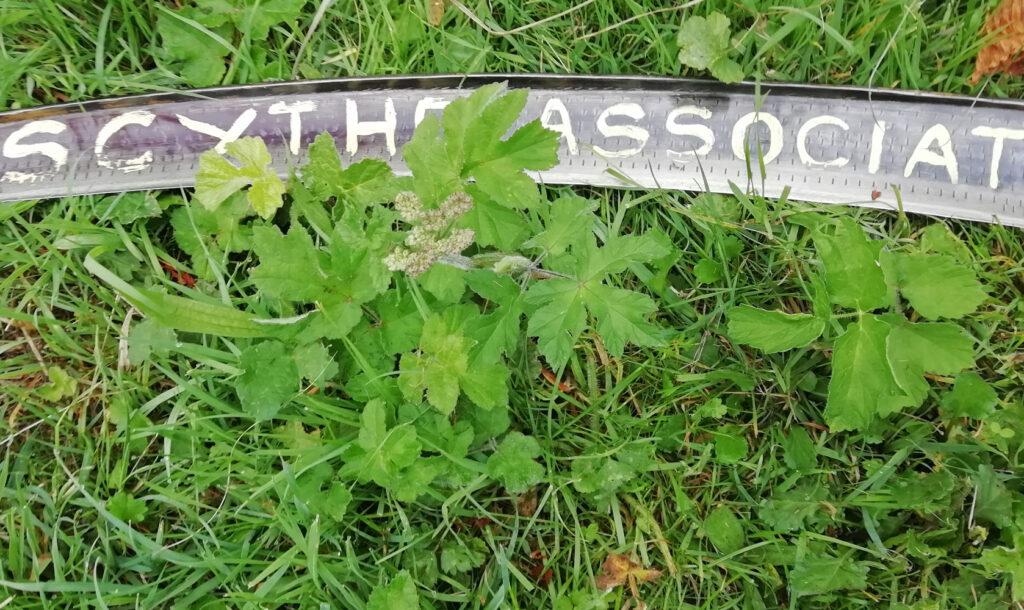
Plants like hogweed have a strategy of rapidly pushing up new leaves after mowing in a bid to over-top and shade out less vigorous plants and gain a territorial advantage. There is however a weakness in this strategy as the fresh growth is prominent and exposed, and because of its rapid growth often quite succulent and tender. Plants also have to commit considerable resources to this rapid growth strategy. A hungry cow grazing the aftermath will soon undo this plan: cows apparently relish and will selectively graze young hogweed.
I do not have any livestock to do the job for me, fortunately however the exposed precocious growth of hogweed is very easily scnicked off: selectively topped with my scythe. I take my longest blade (a 110cm competition blade) and set it up with a wide hafting angle. I then glide the blade over the sward with very light down pressure such that the bottom grasses and short herbs resist, support and carry the blade and are hardly touched. By contrast the exposed floppy lush hogweed leaves can’t escape and yield to the scythe with satisfying ease. With an open hafting angle I can take deep wide swipes at each stroke and progress really fast across the meadow . Other robust tall herbs like knapweed, and more vigorous grasses are also usefully topped.
Footnotes
Henry Wadsworth Longfellow’s poem, “Aftermath” alludes to a number of other interesting autumnal mowing concepts worth mentioning here. (first bought to my attention in a SABI discussion on facebook)
Aftermath
When the summer fields are mown,
When the birds are fledged and flown,
And the dry leaves strew the path;
With the falling of the snow,
With the cawing of the crow,
Once again the fields we mow
And gather in the aftermath.

Not the sweet, new grass with flowers
Is this harvesting of ours;
Not the upland clover bloom;
But the rowen mixed with weeds,
Tangled tufts from marsh and meads,
Where the poppy drops its seeds
In the silence and the gloom.
Rowen: a stubble field left unploughed until late in the autumn, so that it can be cropped by cattle (or perhaps mown as the poem suggests)…”mixed with weeds”, …. “Where the poppy drops its seeds” Rowen is also sometimes referred to as aftermath, being a second crop of grass following a corn harvest.
Litter-meadows. Described by George Peterken in his book “Meadows” as rough areas of vegetation that are cut just once in autumn for animal bedding (has little or no fodder value). In Britain Fen-meadows of coarse grasses sedges and reed were sometimes cut as marsh-hay for bedding: the “Tangled tufts from marsh and meads,” in Longstaffs poem. Autumnal if not strictly after- math.
Other less poetic concepts
Foggage – a crop of grass left standing unmown in the field set-aside to be grazed by livestock in autumn/winter. Could be math or aftermath grass. It would be of very poor feed quality but a useful back up where hay was in short supply.
Overstood – Meadows which are not cut around the optimum haytime in midsummer (around July) are described as being ‘over-stood’. In this phase the grass and herbs shed their seeds to the ground, draw down any remaining nutrients from the upper foliage into their roots. By autumn a large part of the upper growth dies back, ultimately collapsing in a tangled blanket that then rots from the base up.
Foggage has become more popular in recent years but is now known as “extended grazing”. As it says on the tin, the idea is to extend the period when, particularly milking cows, are out to graze.
There has a lot been written about it in the farming press but broadly you enlarge the area available to the cattle for grazing by bringing land cut for silage into the grazing cycle. You then extend the time interval between rotational grazings to build up a “wedge” of grass. Usually you would apply extra nitrogen fertilizer to encourage new growth.
Grazing then continues on into the autumn for as long as soil conditions allow. Soil damage is often reduced by only allowing the cattle out to graze for a couple of hours each day. Grazing stops when the ground becomes too wet and grazing recommences where it was left off as soon as soil conditions improve in the spring.
The idea is to maximize the use of the cheapest food – grazed grass. Extended grazing is not without its risks. Soils can be damaged by trampling and the sward can become overstood. One of the greatest risks of overstood grass used to be increased frost damage but I suspect that is less now.