

A bent or broken ring clamp on a scythe is a clear symptom of incorrect scythe set up, and this typically associated with, and exacerbated by, poor mowing technique.
A replacement ring clamp can be fitted, but to fully remedy the problem (so it does not happen again) it is necessary to review and correct, as needed, the following causes and faults.
- Ring clamp not positioned securely towards end of snath
- Hafting angle too wide
- Poor mowing technique – Hacking rather than slicing
- Blunt blade
- Using excessive force (normally as result of the above three points)
- Tasks too tough or woody for the scythe
A correctly fitted clamp with proper setting and mowing technique should give years of service without breaking or distorting. If the clamp fails this is telling you something.
Do not be tempted to think that a stronger clamp would be the answer. A stronger clamp would pass the excessive force applied into the snath and break this instead. A replacement clamp is only £10 whereas a snath is £72.
A distorted clamp can usually be reshaped with a hammer and vice then refitted after checking all the points that follow.
1. Ring clamp position
It is important that the ring clamp is fastened close to the end of the snath NOT close to the lug end of the tang as shown in the photo below. This is the most common primary cause of bent or distorted ring clamps.
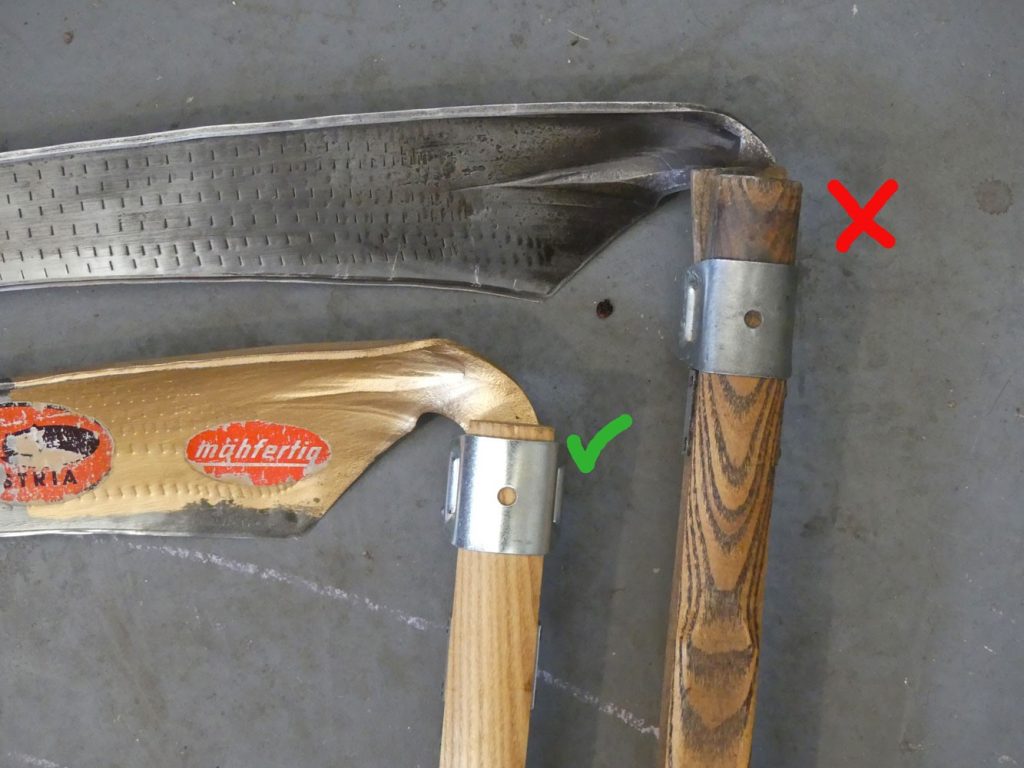
It is helpful to think of the blade as long lever applying force through the tang attaching to the snath, and with the lug being the fulcrum.
The clamp experiences and resists these leverage forces. The closer the clamp is fitted to the lug/fucrum the greater the leverage force transmitted to the clamp. A clamp fitted closer to the lug end of the tang will experience double the leverage forces as compared to a correctly fitted clamp close to the end of the snath.
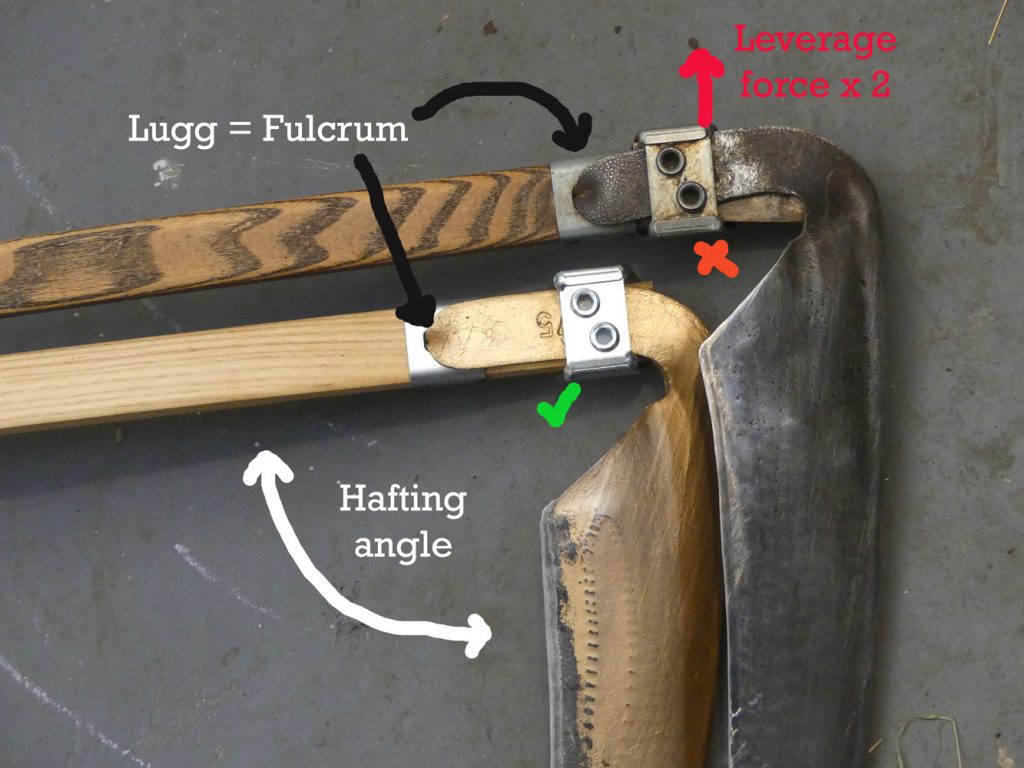
The result of incorrect clamp positioning is that the blade tang is less secure and likely to slip out of position being unable to resist the increased leverage forces. The tang will end up pushed up against the clamp, and if not corrected will continue to exert force against the clamp bending or breaking it.
Note: The clamp will not quite adjust to fit right at the end of the snath: the maximum point is limited by the curved neck of the tang.
2. Hafting angle too wide
The hafting angle must be set correctly both for mowing efficiency and to avoid damage to the clamp and snath.
The hafting angle is the angle between the blade and the snath (see fig 2).
A correctly set blade hafting angle should be balanced such that the forces trying to pull the blade away and out of line are minimised. Assuming you have developed a good mowing stance and style a correctly set blade should flow smoothly through the entire stroke. In this condition the strain on the clamp, the snath, and indeed your body, are minimised
A mower with some experience will soon be able to feel the difference of resistance between a correctly set blade and one which has just slipped out of adjustment (for example after hitting a tussock or mole hill). You can easily visually check to confirm if this has happened: the tang will be fully open and pushing against the outer side of the clamp as in the badly set (upper) scythe in fig.2
Always carry an allen key with you in the field so you can monitor and correct the hafting angle as and when required.
If the angle is set too wide/open (or slips into this position in use) the blade will grab too much grass.
The resulting strong pull of the grass will then tend to deflect the blade out further away from the user, taking on an ever-increasing amount of grass.
The scythe will stall when this increased resistance against the movement of the blade becomes too great.
The more grass the blade tries to push against the more the leverage forces will be magnified, straining the clamp and snath.
3. Poor mowing technique – Hacking rather than slicing
Slicing: A scythe used correctly will present the blade to the grass at a very shallow angle and slice only a narrow strip of grass with each stroke.
Hacking: swinging the scythe into the vegetation at a steep open angle so the blade is forced to attempt to chop square-on a depth of grass approaching the length of the blade. This is quite likely to break the clamp, the snath as well as the user. It will not work effectively either; at best it will sever the tops of the vegetation and push flat the growth at the base.
Untrained scythe users will often hack rather than slice by default as they incorrectly guess that this is how the tool should be used. They also assume that the blade length determines directly the depth of cut they should aim for. Watch Poldark for the classic example of this! They usually give up and abandon the scythe as being from their experience a useless tool.
4. Blunt blades
Simply put a blade must be sharp at all times and for all tasks to work effectively and with minimum effort. A blunt blade will require way more force and energy if it is to cut anything. This excess force will also be multiplied by each of the strains generated by the other faults listed above.
5. Using excessive force
Many inexperienced mowers attempt to compensate for blunt blades, poor setting and bad technique by simply applying more brute force. Whilst this might go some way to overcoming say an incorrect hafting angle, but it is not efficient. Mowing will be hard and tiring and there is the increased risk of damage to the scythe.
I have even had some gung-ho mowers tell me that they feel that they will get more work done by powering into the job hacking, and not worrying about niceties of technique. These mowers did not cut more grass; they just ‘felt’ that were doing more because of the big increase of effort and sweat required – oh and they broke their scythes!
There is no substitute for good training in the efficient use of the scythe, not just to learn how to mow with the minimum of effort and strain, but also to be able to recognise when the hafting angle is wrong or the blade needs sharpening.
5. Task too tough or woody for the scythe
Austrian scythes are lightweight ergonomic tools perfect for mowing meadows and grassland. They are incredibly strong and can if used correctly tackle rough grassland with some woody growth such as one year growth of brambles and tree suckers.
Rough tussocky and overstood grasses and brambles are harder to mow, they present more resistance to cutting than fresh well managed meadow grassland. In this circumstance all of the aforementioned points about set up and technique become all the more critical.
When tackling difficult vegetation take even smaller slices, nibble your way in, only take small bites with each stroke (reduce both the width of your swath and the depth of cut). If you encounter significant resistance part way through a stroke, don’t push harder, just back off your blade and come in again (at a shallower depth if needed), you will often find it will yield at the second attempt.
Plan each stroke and don’t be tempted to stop thinking and just power through regardless. If you have ever tried to hack a well-developed grassy tussock you will have found your blade pretty much bounces back off it and the tussock is still there laughing at you!
There are some tasks that I believe are simply too challenging for an Austrian scythe and beyond what they are designed for.
There was a specific type of traditional English scythe designed specifically for rough tasks. This English ‘Briar’ blade and snath combination is more robust than either English Grass scythes, or Austrian scythes. They have twice the weight in the blades, twice the amount of wood in the snath, and clamps to match.

There are jobs where a slasher, bill hook or mattock would be the better choice of tool for the task
See also my article on choosing scythe blades for rough mowing
Woody growth
Occasional individual woody stems can be safely dealt with using any blade to get them out of the way. Thicker stems should be tackled individually. Do not reach back and swing in but start the cut close, or even in contact with the stem. Use the heel end of the blade. Pull the blade upwards though the stem away from the ground (rather than level with the ground as when mowing grass) to deliver an angled slicing cut along the wood fibres rather than squarely across the grain. It sometimes helps to tread on the stem to bow it over to get a better angle of attack. Be aware that this will leave some sharp pointy tip pegs (stumps) which could be a hazard if stepped on with thin soled shoes. Best practice would be to go back and grub them out with a mattock. This also stops them regrowing as a coppice.
Blade length – a final note
The longer the blade the greater is the potential leverage that can be exerted through the tang to the clamp and snath. What this means is that the errors of incorrect set up and bad technique are likely to be magnified where a longer blade is fitted.
Shorter blades are in some sense seen as more ‘forgiving’ of bad set up and technique. This however is only true to the extent that it possible to ignore and push through the errors using brute force, and because the total amount of damaging strain exerted as a result will be limited by the shorter lever that is the short blade.
With the correct setup and slicing technique it is quite possible to mow difficult or rough grassland with a longer blade. All one needs to do is to take smaller bite. For example, a 75cm blade that in easier mowing could manage a 16cm depth of cut should in rough work aim for say just 8cm instead, halving the effort and strain. This is useful where a field is patchy and one can vary the amount cut at each stroke to match changing conditions.
When tackling sites with mainly difficult grass and vegetation shorter ‘ditch’ blades are recommended. Why? Principally because shorter blades are good for mowing between obstacles and over awkward terrain, for example within orchards or along ditch banks. Ditch blades are also generally prepared with more robust edge profiles which are not as sharp but less damage prone than fine edged grass blades peened for meadows.
Where one has mainly difficult neglected grassland to mow and the expectation is to be constantly having to take small bites there is no longer an advantage to using a longer blade – a short blade can manage this. Having a shorter blade does mean less chance of accidentally catching too much grass and straining the scythe. This can be reassuring, and also useful for those with less skill and experience. (Nb. Using a short blade does not make it easier to mow for novices, often the opposite. It just makes it more forgiving in the sense described above.)
Heavy Bush blades for woody growth (which I do not generally recommend for Austrian snaths) have to be short as the risk of snath breakage is particularly high with the force with which they are inevitably used.