
Getting your scythe to fit your own body is key to comfortable ergonomic mowing.
Fitting scythes for others needs a bit of forethought and planning. This is particularly true as I have found when supplying scythes at a a distance by mail order.
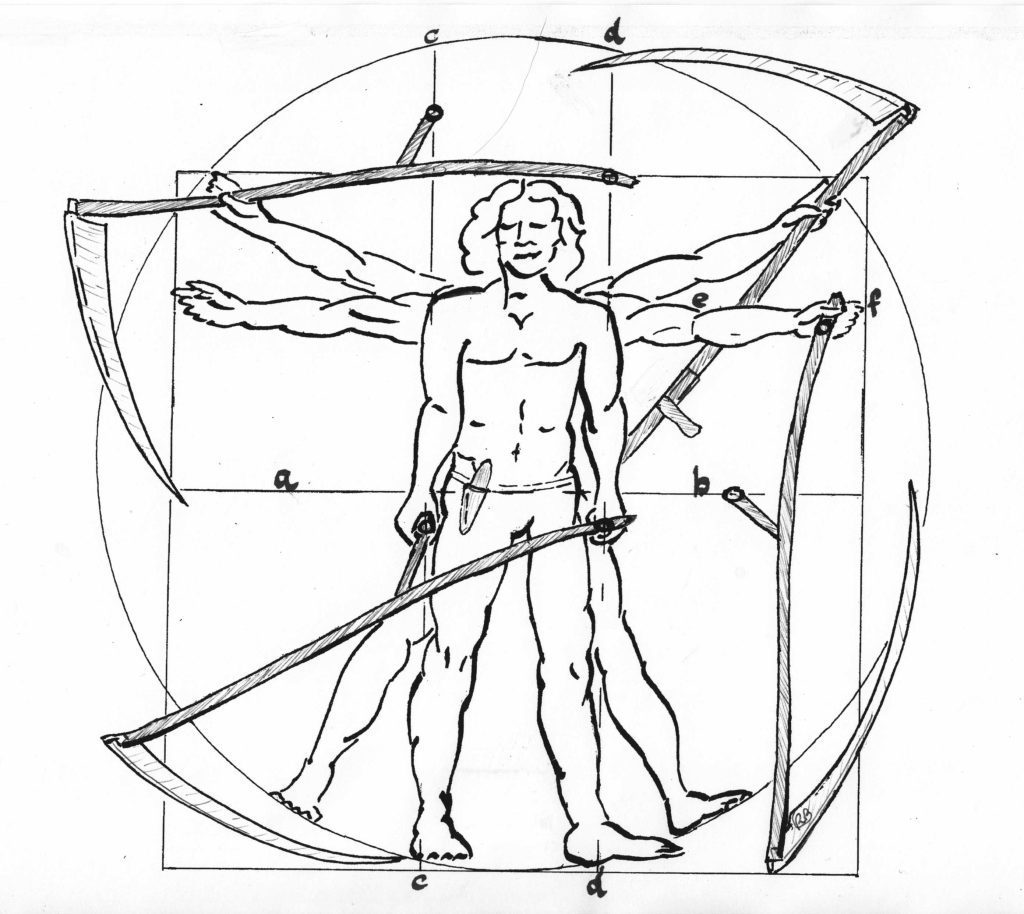
To prepare better for future fittings I decided to research more into the proportions of the human body. Inspired by the idealised form of Leonardo da Vinci’s Vitruvian man I drew my own interpretation diagram as to how this relates to scythe fitting.
Lower grip position
Hip Height (trochanter leg Length)
Line a – b in the diagram above is the hip line and shows its relationship to the lower grip position on the snath
With the snath held vertically to one’s side the lower grip should be fitted in position corresponding to hip height
The hip line is at the widest point of the hips and not the pelvis or waist higher up.
It corresponds to the outer end of the leg’s hip joint at the head of the upper leg bone (femur ).
This outer bump on the hammer-head shaped hip joint is is called the greater trochanter and can be felt close to the surface – it will move slightly if you lift your leg (whereas your pelvic bone above will not).
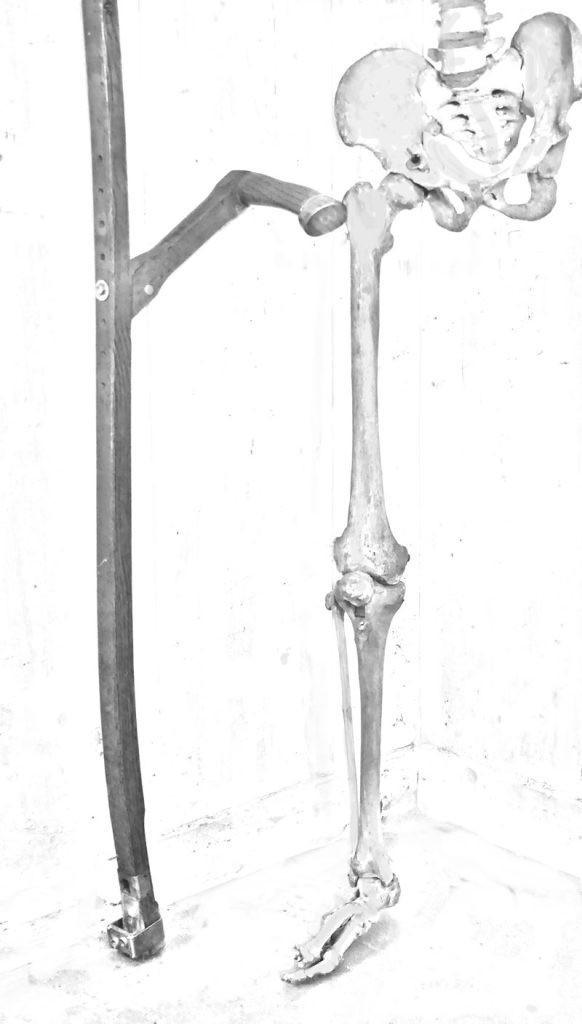
The height of the lower grip from the floor thus corresponds to the full length of the leg measured from the heel to the Greater trochanter.
For regular mowing the lower grip handle (at b) should be set to this level when the snath is stood vertically against the body.
The hip line is also the central axis of movement, power and control of the body when mowing.
Upper Grip position
The distance between c and d = shoulder width.
Lines c – c and d – d shows the scyther’s alignment of shoulders with hands, grips and feet.
If the distance between the lower and upper grip handles are set to correspond to this so that the arms hang down naturally to meet the grips comfortably.
For setting up a scythe this measurement is also approximately equal to the distance from elbow (e) to fingertip (f) = one cubit. The forearm (e- f ) can be used to gauge the position of the upper grip by resting the elbow on the lower grip and fixing the upper grip to the first hole beyond the fingertips extended against the snath.
With the scythe held vertically against the body and the lower grip against the hip the upper grip (at f) will be approximately 1 ½ times hip height – about the height of the arm pit.
Mowing Position
The feet are positioned at c and d for maximum stability in regular mowing.
The outer square box frame (= body height and outstretched arm span) roughly corresponds to the width of swath cut in closed upright mowing styles.
The outer circle drawn from the body centre (at navel) similarly roughly corresponds to the width of cut in open field mowing styles and is about 20% more than height/arm span. The feet usually move further apart in this more energetic style.
In reality each person has their own conformation and style and should endeavour to tune their scythe to be in harmony with their body to make mowing as effortless and pleasurable as possible.
To mow freely, especially when going for a wider reach, you may find it more comfortable to open up these settings by moving the lower grip 5 – 7cm above the hip line and increasing the distance between the two grips by up to 10cm.
Note: Whilst the snath dimensions are to scale with the body, the orientation of snaths and grips to blades in the drawing are positioned for illustrative convenience (artistic licence with hafting angles and perspective).
Snath Sizing Guide
The two main sizes of the Schrokenfux wooden snaths I supply are:
snath size 2 – (150cm) – for people 5ft to 5ft 9″ in height
snath size 3 – (160cm) – for people 5ft 9″ to 6ft 3″ in height
There is quite an overlap between the the hole positions on these two sizes. People around 5ft 9,” plus or minus a couple of inches, could probably adjust either snath to fit them.
If you are in the middle deciding factors could be one or both of the following:
- if you are long in the leg for your height go for the longer option (& vice versa)
- If you are sharing use with a taller person go for the longer option (& vice versa).
There is also a size 1 snath available for youngsters and people 5ft and under, and a size 4 snath for people over 6ft 3″ tall or taller people over 6ft with long legs for their height.