
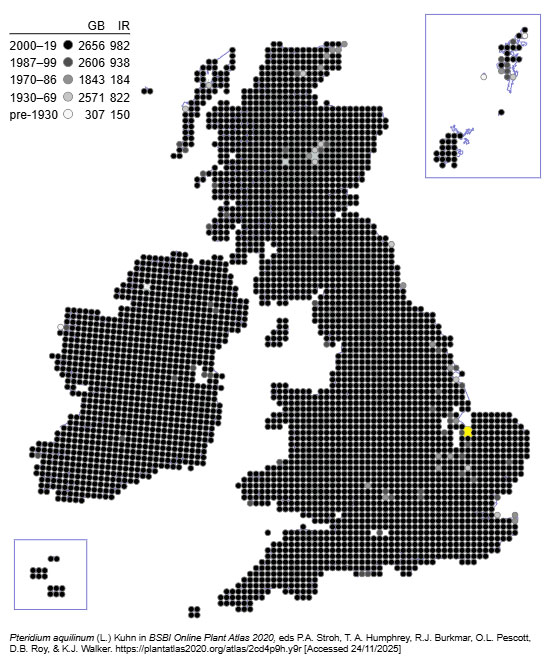
Bracken is a native pant that can be found growing in almost every part of Britain. Living in the Fens in Norfolk I am in one of a very few BSBI atlas hectads in the UK that does not have any bracken (yellow dot on atlas below). Until this year I had no personal experience of cutting bracken with a scythe.
This year I decided to fill this knowledge gap by mowing bracken on two sites: one in the Shropshire Hills, and one nearer to home in the Brecklands. The following are my notes and observations that followed from this.
Background
Bracken is a native plant and can form valuable habitat. It is however a very competitive plant with the potential to colonise, dominate and replace other vulnerable habits such as species rich grassland and heathland.
When bracken grows “in the wrong place'” and proves difficult to push back, it becomes a problem “weed” by this very definition.
Bracken has become more of a problem in recent centuries, this mainly attributed to changes in land use such as the shift from cattle to sheep grazing, and of management including a reduction in the exploitation of bracken as a useful crop.
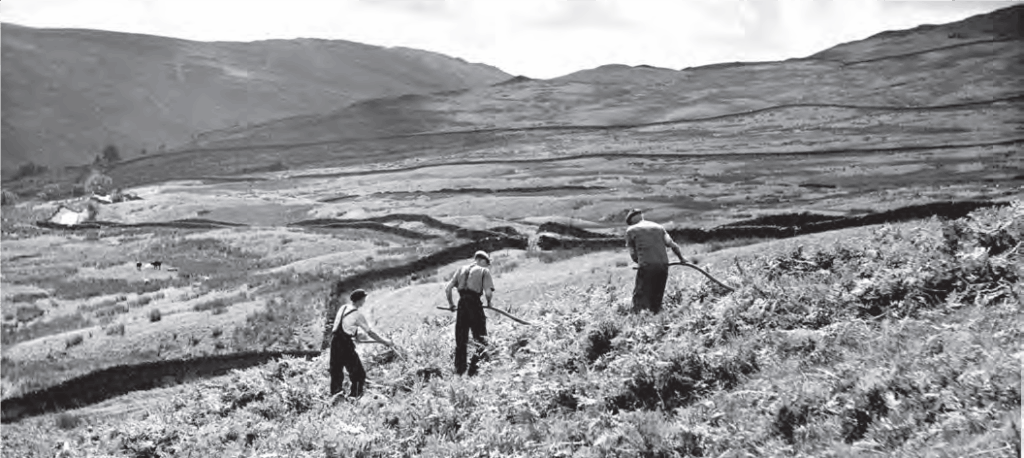
Changes as a result of global warming and rewilding could lead to it taking over more land in the coming years.
Bracken does not need controlling everywhere. Bracken management only becomes a consideration where it is becoming an overbearing problem. Bracken management effort should be targeted only where it is possible to make a positive impact on the quality of wildlife habitats and the landscape.
Examples
The two locations I visited this summer are useful examples of employing different mowing strategies using scythes.
Shropshire Hills bracken control at Stiperstones NNR
Much of The Stiperstones is heathland dominated by heathers and bilberry.
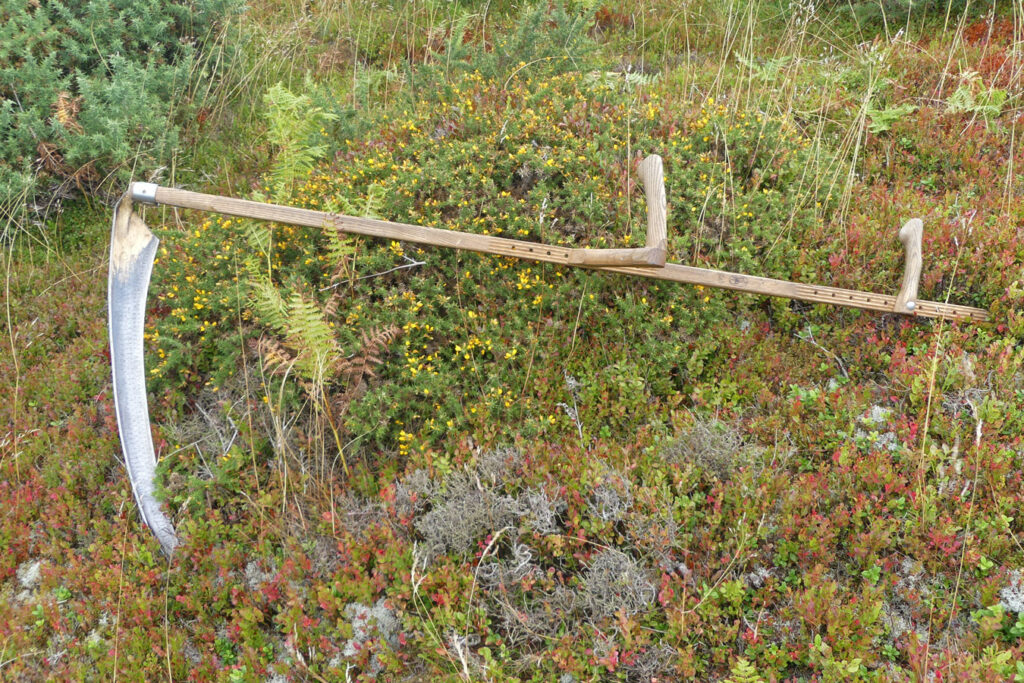
There are also areas of species rich acid grassland: pasture and upland meadows with plants including harebell, heath speedwell, heath bedstraw and mountain pansy. Management including grazing, mowing and burning, is important help to prevent the encroachment of bracken, scrub and trees in order to maintain the exceptional habitat and landscape quality of the area.
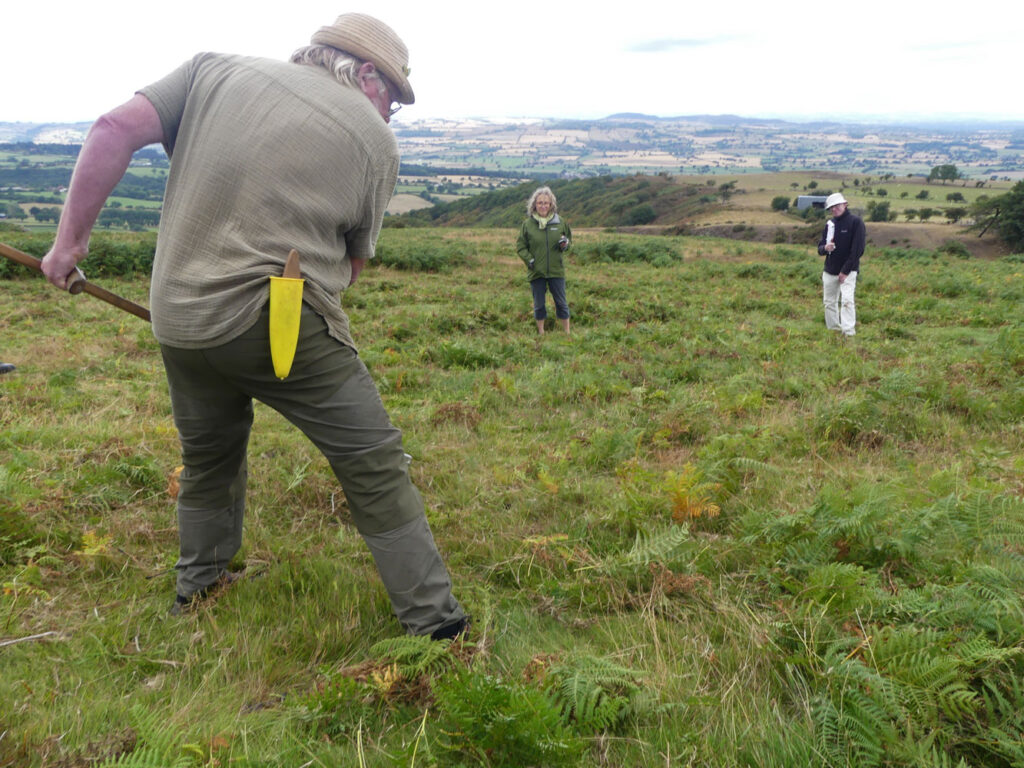
The scythe mowing I took part in was part of a general programme of regular cutting of bracken regrowth in Stiperstones grassland. The aim of this management is to weaken and supress bracken, this in turn benefits the health and dominance of grassland plants. In pastures where this had been rigorously applied over a number of years the residual bracken fronds were sparse and weak and very quickly and easily dealt with walking over the area with a scythe.
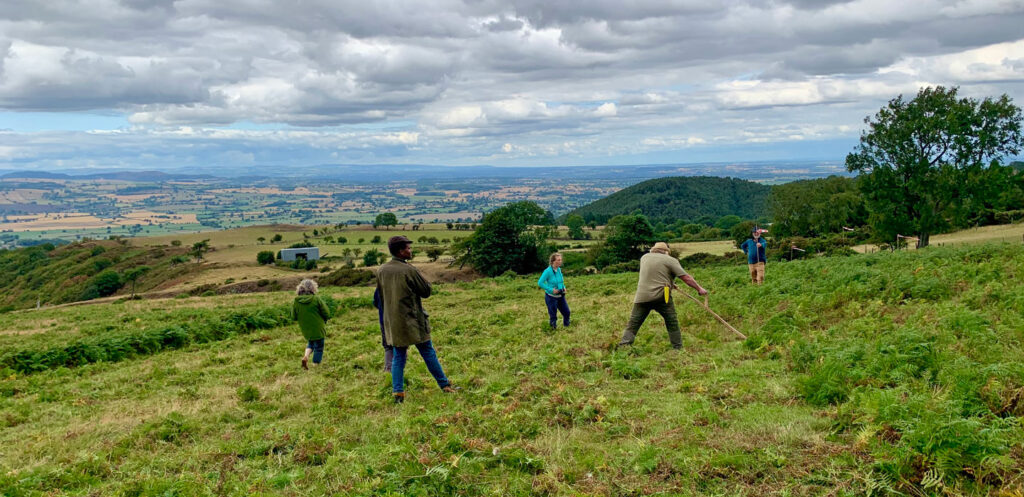
In another grassland area we tackled with scythes the bracken was only partially supressed by past management. This area had been tractor mown once in 2024, and in sporadic years before that. It is grazed generally in the winter once the cattle and sheep are off the hill. As a result, it was not a head height ‘forest’ of dominant bracken but a moderately open bracken stand approximately 50cm high loosely spread over a relatively level area with short grass underneath.
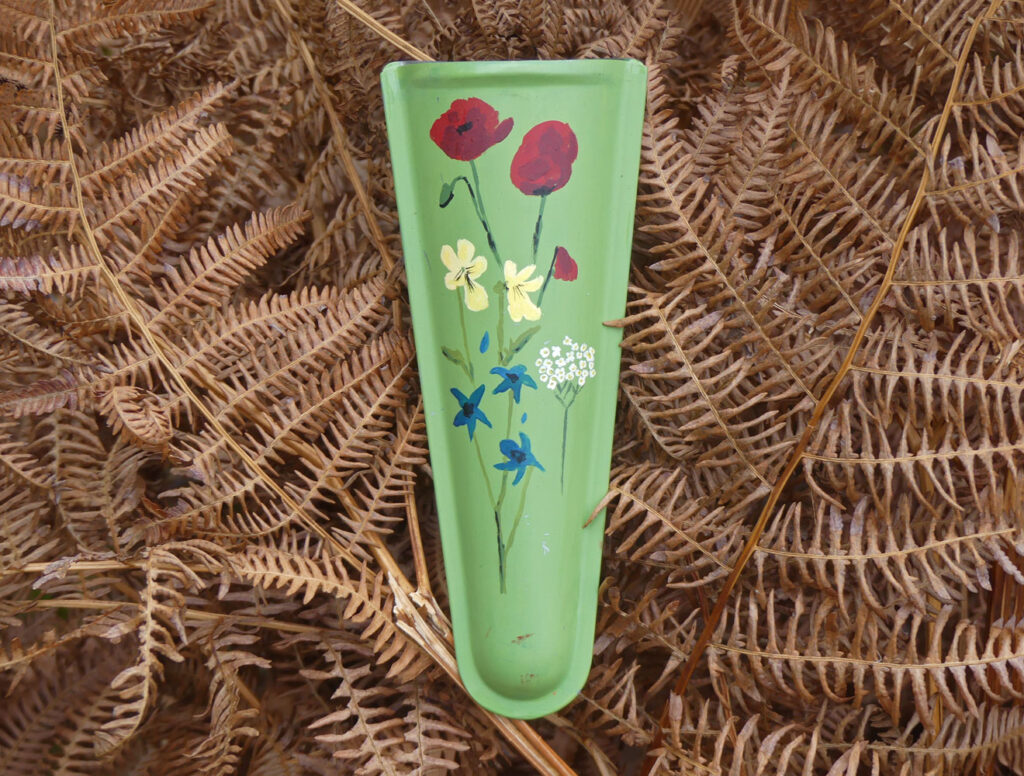
If scything in this beautiful Shropshire landscape was not enough, for additional fun a bracken mowing competition was organised on this section. I am pleased to report that I won this competition becoming possibly the first ever bracken scythe champion ever! (see scytheassociation.org/shropshire-hills-bracken-scything-competition-2025)
Breckland mowsaic patch mowing East Wretham Heath NNR.
The main areas of this Breckland open-heath grassland reserve are managed by grazing and tractor mowing.
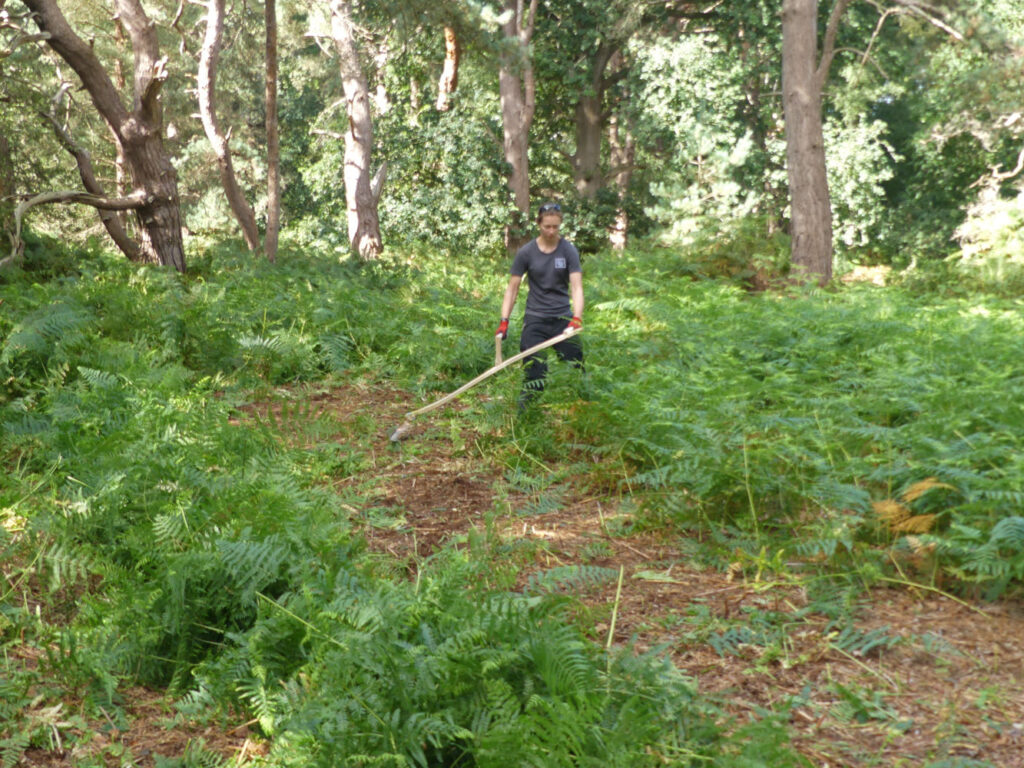
I joined a Norfolk Wildlife Trust work party using scythes to clear bracken in targeted patches along the scots pine and birch wooded margins. The scythe is an ideal tool for targeted bracken cutting, and the neat double windrows (as bottom left in above photo) make clearing the cut bracken into habitat piles easy.
Transitional zones from grassland to woodland can be particularly valuable for wildlife. Rather than completely control bracken the aim of this management was to enhance this transitional habitat by cutting back sections of dominant bracken to create wavy scalloped edges with more structural complexity with a greater variation in size and density of bracken, and of litter accumulation at ground level.

The cut bracken was placed in habitat piles along the new wavy margin. These sheltered dry bracken heaps are very popular refuges and basking sites for adders. Indeed whilst mowing we were lucky to get a glimpse of an appreciative adder basking on a heap (in photo above).
Bracken control Strategies
Like many other competitive dominant weeds its power to bully other plants is a combination of
- vigorous tall growth to shade out its neighbours,
- building a suppressing persistent litter mulch at soil level and
- an active underground reserve of rhizomes for rapid recovery from damage and to spread vegetatively.
Understanding this allows one to formulate strategies to weaken its power.
Mowing to reduce vigour
Cutting back bracken with a scythe is a very effective way to instantaneously reduce the vigour, size and competitive ability of bracken.
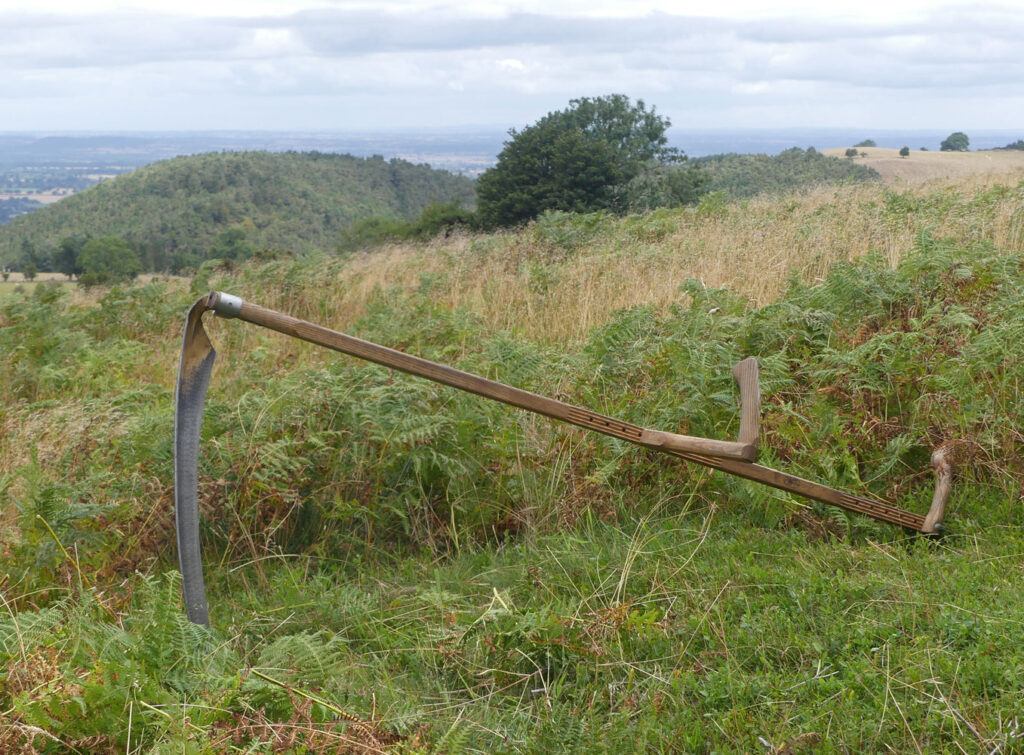
Bracken however easily regrows using its underground reserves so it will need repeat cutting 2 -3 times through the growing season.
As with many other competitive weeds (such as thistles) the most impactful cuts will be in early and midsummer (latest June/early July) when bracken has invested its maximum commitment to above ground growth.
Cutting before its mature fronds have time to feed new rhizome expansion below ground is most effective at depleting its reserves.
Cutting more often to minimise bracken shading promotes the recovery of an understorey grass and flower community which is then more able to compete with and even help supress bracken.
A single cut at the end of the season has little impact on the vigour of the bracken. In the Brecklands, bracken harvesting for bedding was only permitted after 29th of August each year so as not to weaken the crop for future years. A single late cut will also be too late to permit recovery of desirable understorey vegetation.
Bracken is very resilient and difficult to completely eradicate. A mowing regime will need to be in place for at least two to three years to make a big impact. If at anytime management is relaxed the bracken has the potential to bounce back.
Cuttings removal
Removing cut material is important as if left it just tops up bracken’s growth supressing ground mulch. As always removing cut material removes surplus nutrients which can help to encourage plant diversity.
Once removed the pre-existing litter layer is exposed and this will decay over time. Without the protective frond blanket and a shallower litter layer the bracken rhizomes are more exposed to being knocked back by penetrating frosts.
Cut material can be put into habitat piles, composted, or used as much or as animal bedding (not feed).
Source Material
Marrs R H, and Watt, A S 2006 ‘Biological Flora of the British Isles: Pteridium aquilinum (L.) Kuhn’. Journal of Ecology 94, 1272-1321
SEARS 2008 Bracken control: a guide to best practice (www.sears.scotland.gov.uk)
Campbell, G and Pelling, R 2013 The Palaeoethnobotany of Pteridium aquilinum (L.) Kuhn. (Bracken) -Myriad past and present uses from documentary evidence and the archaeobotanical record. Historic England (Poster presentation)
Hartley, D 2012 Lost World: England 1933-365. Totnes: Prospect Books
With thanks to
Simon Cooter, Senior Reserve Manager, Stiperstones and Downton Gorge NNRs for hosting the competition
Norfolk Wildlife Trust, East Wretham Heath