
The cheap scythe challenge – A new scythe for under £40 including delivery! how bad can it be?
From time to time, I am asked whether one of the ridiculously cheap scythes you can purchase online.(which I will call Internet scythes). Are worth purchasing at all? Can they work well enough to cut back tall vegetation that a lawn mower cannot tackle?
Quality pays in the long run
Clearly in life as the adage goes ‘you get what you pay for’. You can’t expect a £40 internet scythe to be nearly as good as a more expensive top quality Austrian scythe: to mow as well, to be a pleasure to use and for it to last many seasons.
If you have a serious or even moderate amount of mowing to do each year with a range of tasks from meadows to lawns to rough ground it pays to invest in the best tool for the job.
Cheap tool cost effective for a one off small task?
But what if you only have a very small patch to knock down or occasional need of a scythe for which you can’t justify the cost of a quality scythe? Could you make do with a cheap internet scythe?
I have tried a wide variety of scythes over the years and know that to get a quality cut you do need a well-set, sharp, quality scythe. But if you are not looking for a quality result or a good mowing experience, can a more basic scythe do a passable job?
If all you want is to roughly top the tall growth from a patch so you can follow up with a rotary mower, sometimes a basic scythe, a grass hook, hand shears or other implement will do.
But a £40 internet scythe? Really?
I could guess, but objectively I didn’t really know the full answer to this question. The only way to find out was to purchase and product test one for myself to determine what it could do, and in what ways it falls short. So this is what I did.
The product test
Product details
vidaXL Scythe with Stone 145 cm
Total cost of scythe £ 39.98 including delivery
Blade 59cm (604g, 1.9mm thickness) made in China.
Snath 145cm, two-part metal with wooden grips
Unboxing and assembly
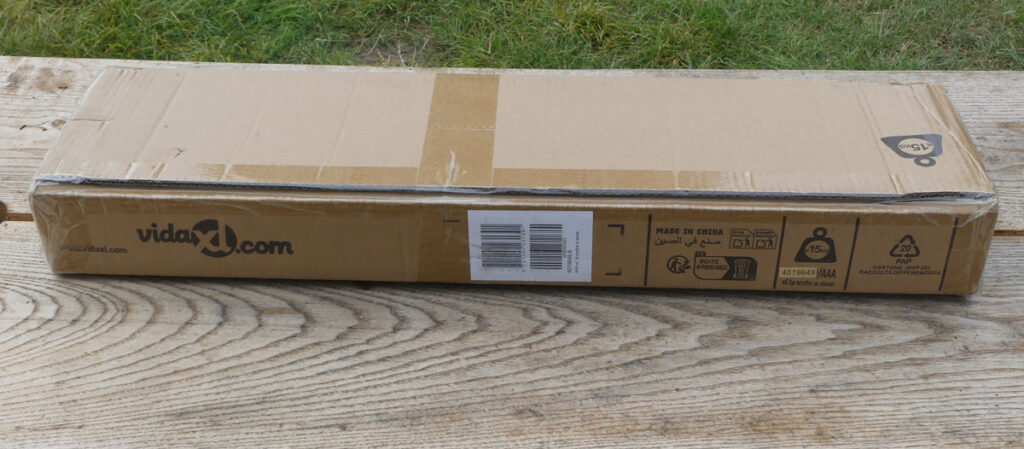
The scythe arrived quickly and in a neat box. Its size helping to keep carriage charges low.
Like self-assemble furniture it came with rudimentary instructions which took me longer to puzzle out than it should. I kept thinking there must be a better way to configure it to make it work.
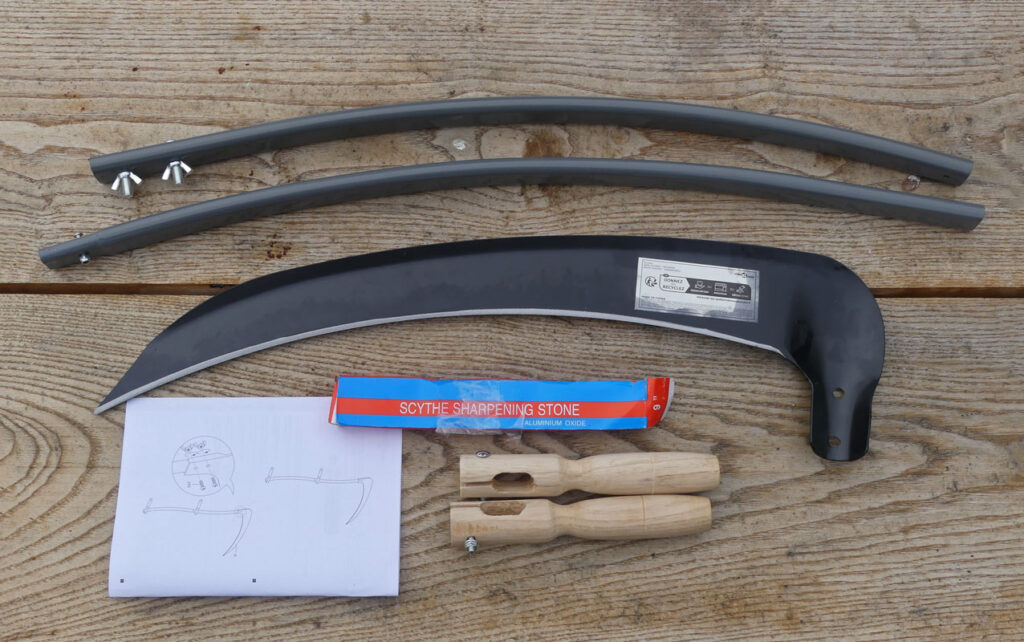
I assembled the scythe as best I could as per the instructions. These say nothing about adjustment.
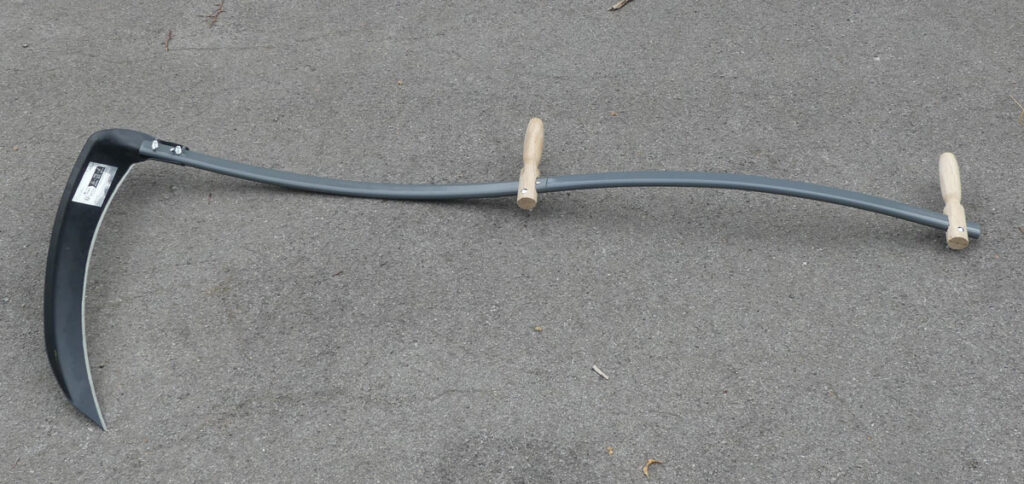
Although the grips are fully adjustable along the snath, it was not possible for me to set them in functional positions. The snath is too short (145cm), its curves too shallow and has no compensating offset for the lower grip.

There is just one position for the blade which is fixed using two bolts. As such there so is no adjustment possible for either the hafting angle or lay of the blade. The hafting angle was approximately OK, but the lay of the blade hopelessly steep what ever grip style I tried.
Undeterred, once assembled I honed the edge and gave it a try out in some fairly easy grass. If a scythe has the potential to cut, I can usually get it to work even if I have to adopt an unusual movement and uncomfortable stance.
It did cut to some degree but to a very poor basic quality. Mowing for any length of time was not viable.
Remedial adjustments
Next, I decided to see how far I could go to remedy the various faults and shortcomings.
Joints and fittings Most of the snath and grip joints were loose and poor and required further tightening by packing with tape, and wood fillets in the grips and oval steel tube (to better resist crushing when tightening)
Blade
The blade curved downwards to the tip. I reshaped it to give a bit of lift to the tip. This was easy as the steel is very soft and bends with little force needed.
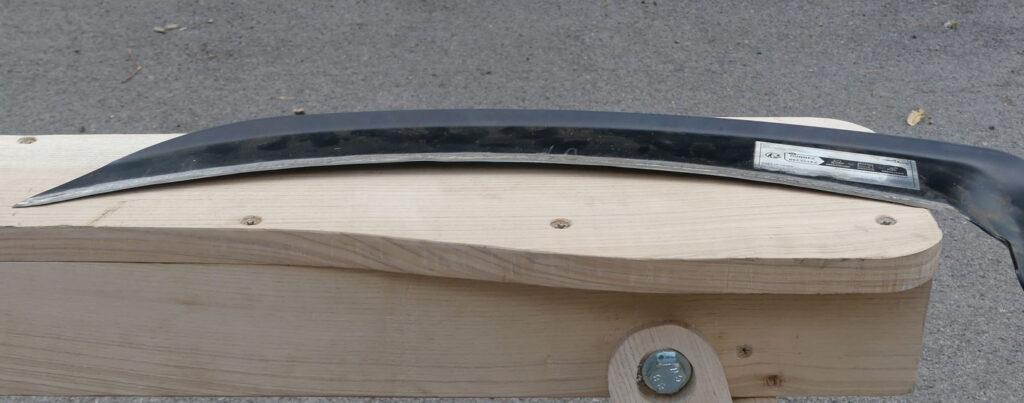
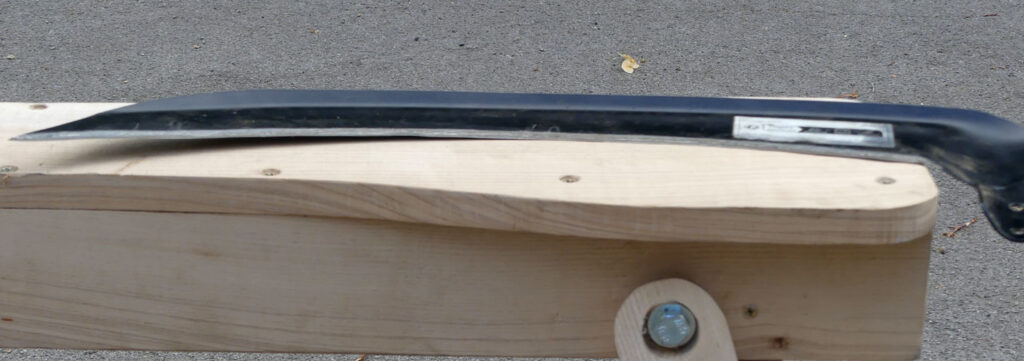
The body of the blade is c.2mm thick. I tested it with my hardness files but it was off the end of the scale (<40RHC) and most likely stamped out of mild steel.
I had a go at peening the edge. Whilst this quickly thinned and reshaped the edge profile I doubt whether this delivered any useful work hardening given it is low carbon mild steel, and the resultant thin profile unlikely to hold an edge well. It didn’t seem to make much improvement to its cutting ability when I tested it again later.
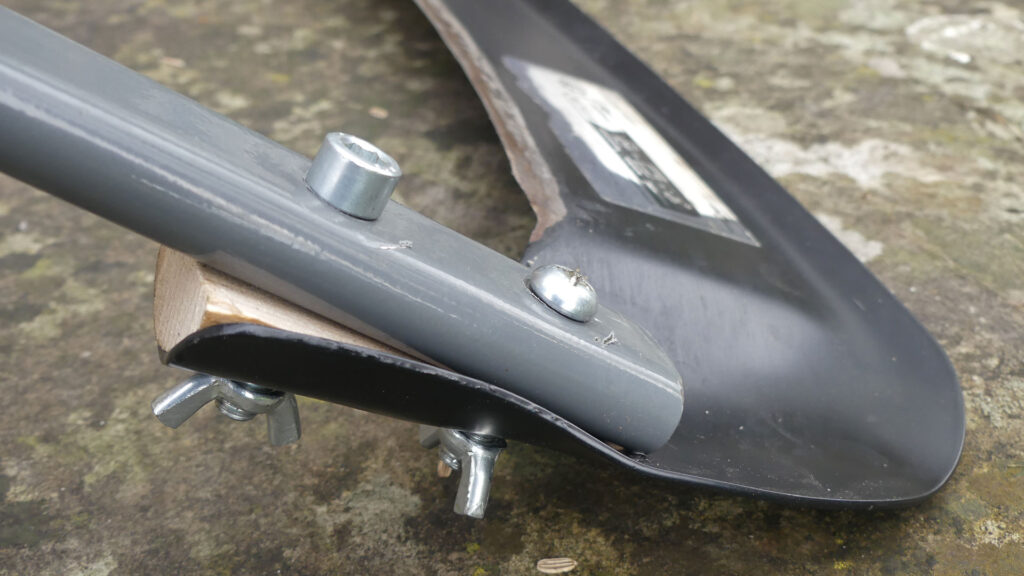
The blade tang is press moulded with a curved channel for strength. This makes reshaping the tang to get a better lay impractical. Instead, I fitted a thick wooden anti-wedge.
In the end I managed to improve the lay and hafting angle (the hafting angle by pointing the upper grip forwards) enough to make a better stance and profile better if not ideal.
Final Testing
In the Autumn I decided to test this internet scythe against a selection of other scythes and blades

I tested and compared all these scythes in three different mowing challenges
- Lush short autumn regrowth
- Overstood meadow grass now flattened by autumn weather
- Coarse tall tussocky grassland
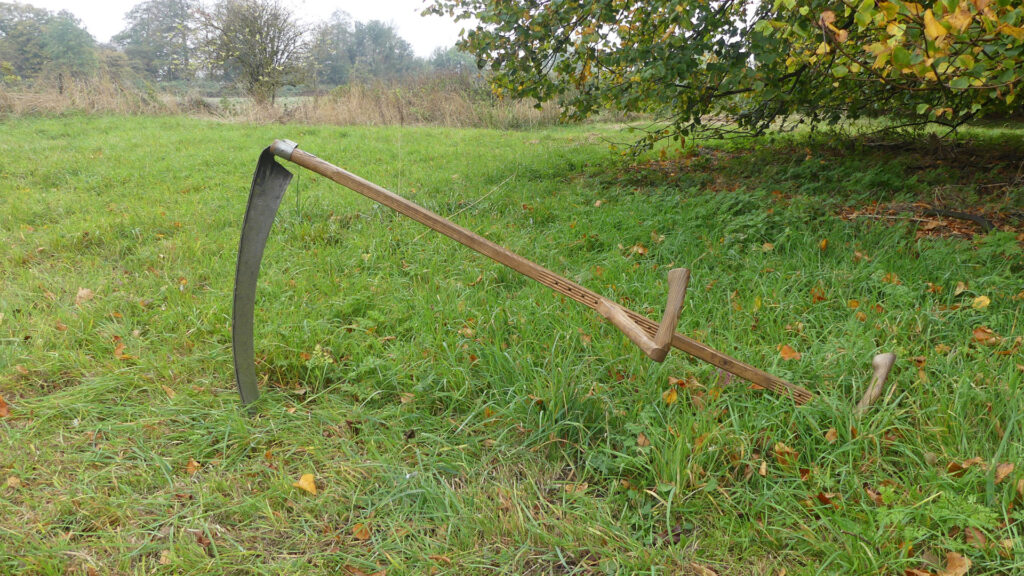
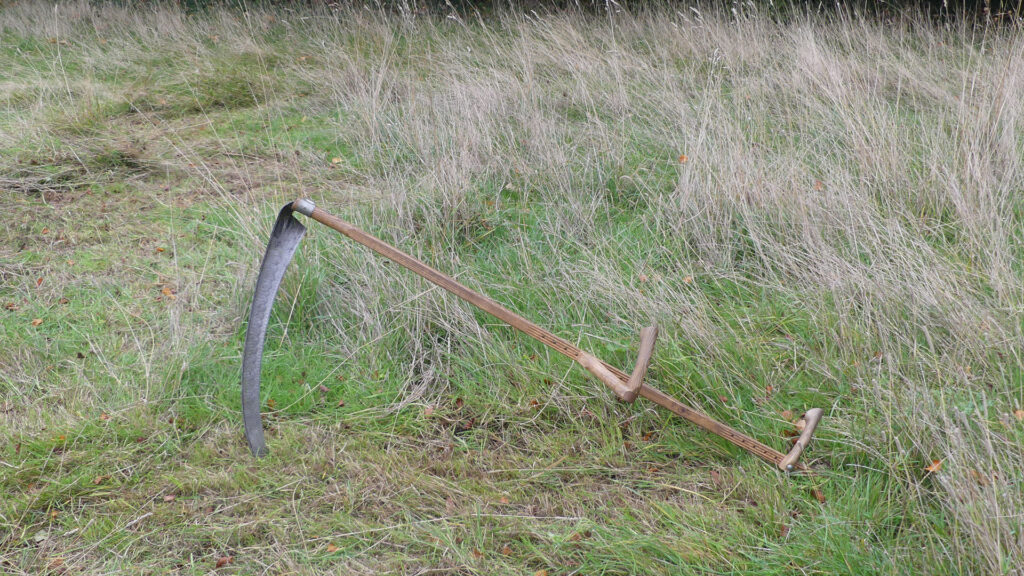
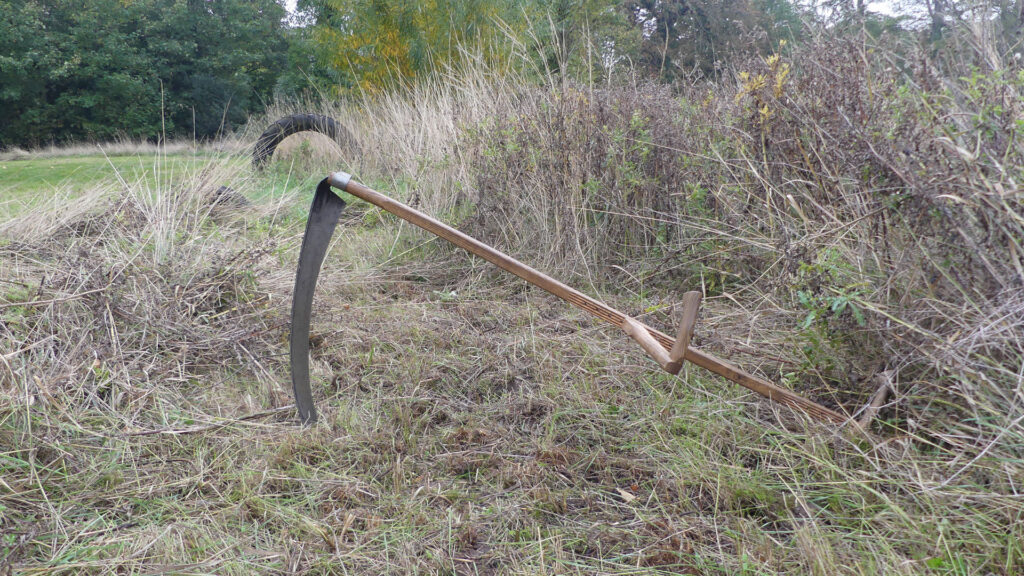
The scythes and blades I included in the challenge were
Cheap budget scythe options
- vidaXL £40 internet Scythe (as modified)
- another cheap internet blade. Neilsen £15 + p&p: 3mm thick. I reground the edge and fitted it to a homemade snath
- A restored vintage English scythe; an example of the type folk often pick up cheaply secondhand and bring to me
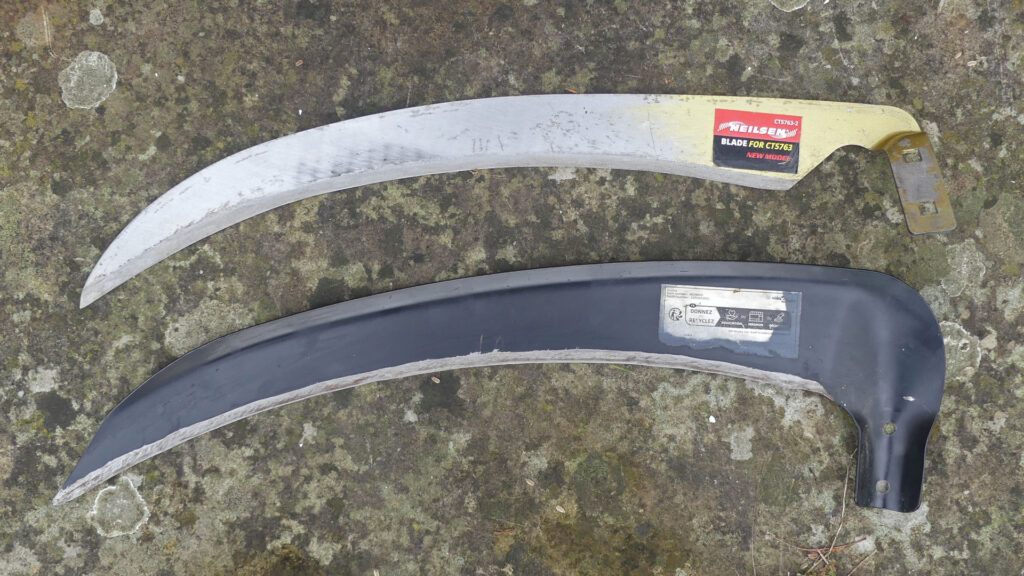
Quality scythe options
- Grass blades (3 of) 60cm -75cm
- Ditch blades (5 of) 55cm – 65cm
Note: I included more Austrian blades in this test as I also used the trial to check a selection of blades I had recently serviced (peened and tang adjusted).
Method
I mowed a section of each vegetation type using each blade in turn.
I did not time mowing speed but rated the result for quality of cut from 1 – 9 as in competitions.
I also gave a subjective feel rating 0-5 for each based upon how satisfactory each felt to me whilst mowing.
Results
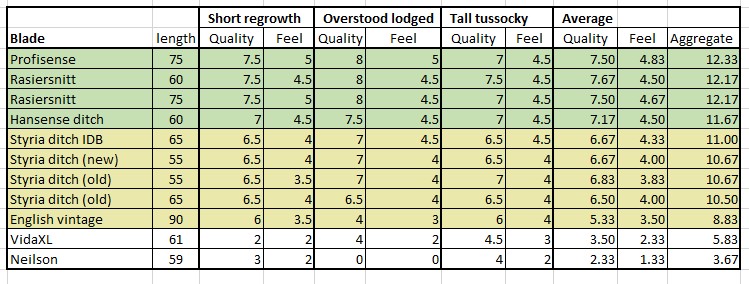
I have added my full table of ranked scores from best to worst at the bottom for those who like data.
Austrian Grass blades consistently performed the best overall in all three vegetation types including tussocky grassland. Any differences between them were insignificant and likely due to random differences in vegetation patches and /or peening.
Austrian ditch blades performed well in tussocky grassland as one might expect. They were good, but not quite as effective as grass blades in short grass or over-stood grass.
The vintage English scythe I tested delivered similar results to the quality ditch blades. For more on English scythes see https://wildscythe.co.uk/english-scythes/
The cheap internet scythes, no surprises here, both models performed very badly by comparison. Both were pretty ineffective on short lush growth so would be useless for mowing lawns. They were capable of topping well-presented stalkier grass, albeit to a poor standard. They struggled to cut where the tussock grassland was denser. The Neilsen blade wouldn’t even touch the overstood laid grass.
Conclusions
The key question I started out with was can a cheap £40 internet scythe be of any practical use even if this means just achieving the very low bar of occasional topping a small patch of tall vegetation, (such as a wild flower mini-meadow in a garden, or knocking down a patch of nettles).
My conclusion is a very qualified yes if there is no better option as I did manage to get the vidaXL to top a small section of my meadow .
But honestly I couldn’t recommend this option to others as I had to employ my full knowledge of set up and sharpening and my experience of mowing styles to get it to cut at all. Their soft steel blades are likely to blunt and to bend out of shape frequently and need constant correction. I doubt that a novice would be able to manage this as many struggle even with well set up quality scythes until they have had some basic tuition.
On this basis I doubt that a £40 scythe would deliver much better results than any other tool from the garden shed employed to whack down grass. I suspect most cheap internet scythes lead to frustration and quickly end up in a recycling skip or car boot sale.
Full Product test data
Well no great surprise, as always you get what you pay for, but thank you very much for taking the trouble to confirm what I expected.
I was once tempted by a dodgy looking item being remaindered dead cheap in a local 4-candles shop, but in the end spent a bit more on a proper ditch blade and never regretted it.
Interesting blog btw – now bookmarked. Thanks. Roger
Yes I pretty much knew the answer but wanted a few more specific reasons to feed back to customers that have asked me about them from time to time.
Thanks for this Richard. Your research and results are always excellent.
It’s helpful to have so much info to pass on to people who are thinking of getting a cheap scythe.
One question – how is the ‘aggregate’ score calculated?
yes Mary, exactly that, I wanted to have some evidence as back up when we are persuading people to invest in quality scythes. As regards my not scientifically verified scoring system, I scored quality out of 10 (as usual) and feel out of 5 (as I couldn’t easily distinguish more than 5 degrees of feel). The aggregate is just these two scores added together just so I could produce a ranking with quality having twice the weighting as feel. But don’t get too hung up on my method as one semi-subjective score (Q) + one very subjective score (F) = doubly subjective !
Perfect, thanks for explaining
Wish I read this before buying an XL Scythe. I also tried peening the blade without much improvement, I found that the snath flimsy , short, the bolts loosened and the blade bent quite readily. I was considering making a longer snath but will not waste any more time on it.
If anything, the above review is too generous. I bought a VidaXL scythe and almost immediately wished I hadn’t. The blade bent on first use… cutting grass! Inferior materials throughout, a two-piece handle with cheap fixings guaranteed to wobble. Overall, this was an expensive way to buy the accompanying (OK) sharpening stone. My own fault for not following the maxim that if it looks too good to be true it probably is. Unusable rip-off as a tool. Do not buy.