
To view this story follow my youtube link below. For more detail read on
In David Tresemer’s seminal book ‘The Scythe Book’ first published in 1981 he describes a trial first undertaken in 1938 by Swedish experimental Archaeologist Axel Steensberg, comparing the cutting efficiency of ancient harvesting tools from flint proto-sickles, to bronze age sickles and right through to steel sickles and scythes. David himself repeated this experiment in the field reporting his results alongside those of Steenberg in his book (p.81).
In my first year scything (2007) I read this account, and ever since I have wanted to replicate the experiment for myself. As you may have noted from my other investigations I cannot rest on an idea without trying it out for myself practically, especially where there are questions begging for answers.
This mission has however had a very long gestation period. it has taken me almost 20 years to get this point. The main hurdle I faced was obtaining suitable replica flint and bronze tools that I could use.
Acquiring the tools
John Lord, an expert Norfolk Flint Knapper, presented me with a beautiful knapped flint sickle at IPD 2022; one he had ‘knocked up’ that afternoon!

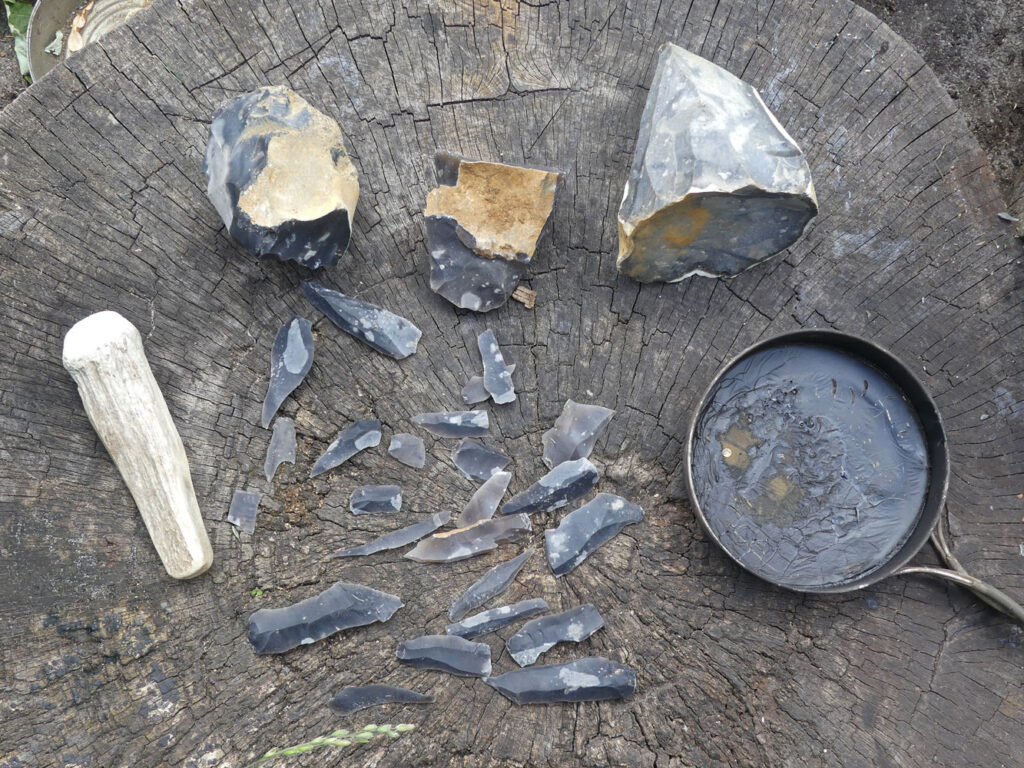
In 2024 John helped me knap some flint flakes and create a second hafted flint sickle mounting the flakes in a wooden handle with pine tar.
The discovery in 2015 of bronze age sickles at the Must Farm site not far from me here in the East Anglian Fens piqued my interest in this quest, but it took me another 8 years to finally source a replica from James Dilley in 2023.
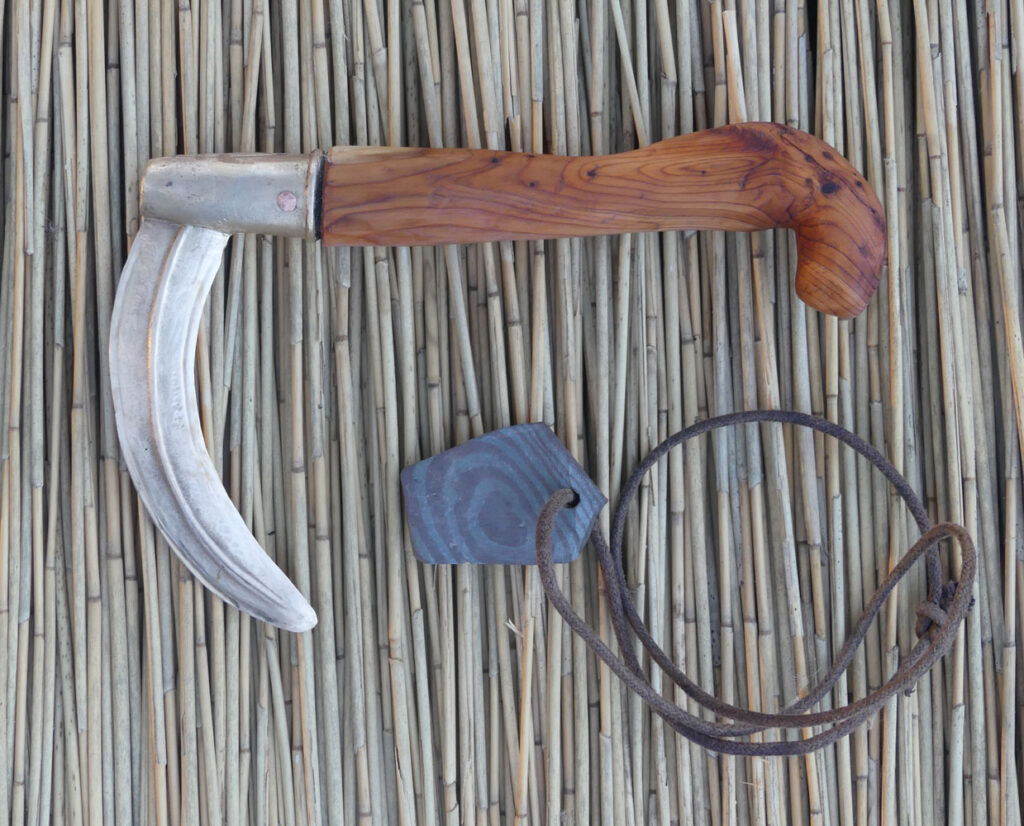
I now at last have the full set of historically accurate implements from flint to modern steel with which to experiment.

Steenberg’s 1940s and Tressmer’s 1980 experiments both cut cereals (barley and oats) the principal crops sickles were used for historically. I do plan to repeat this myself sometime on ancient Emmer wheat (as found at Must Farm) with John Letts.
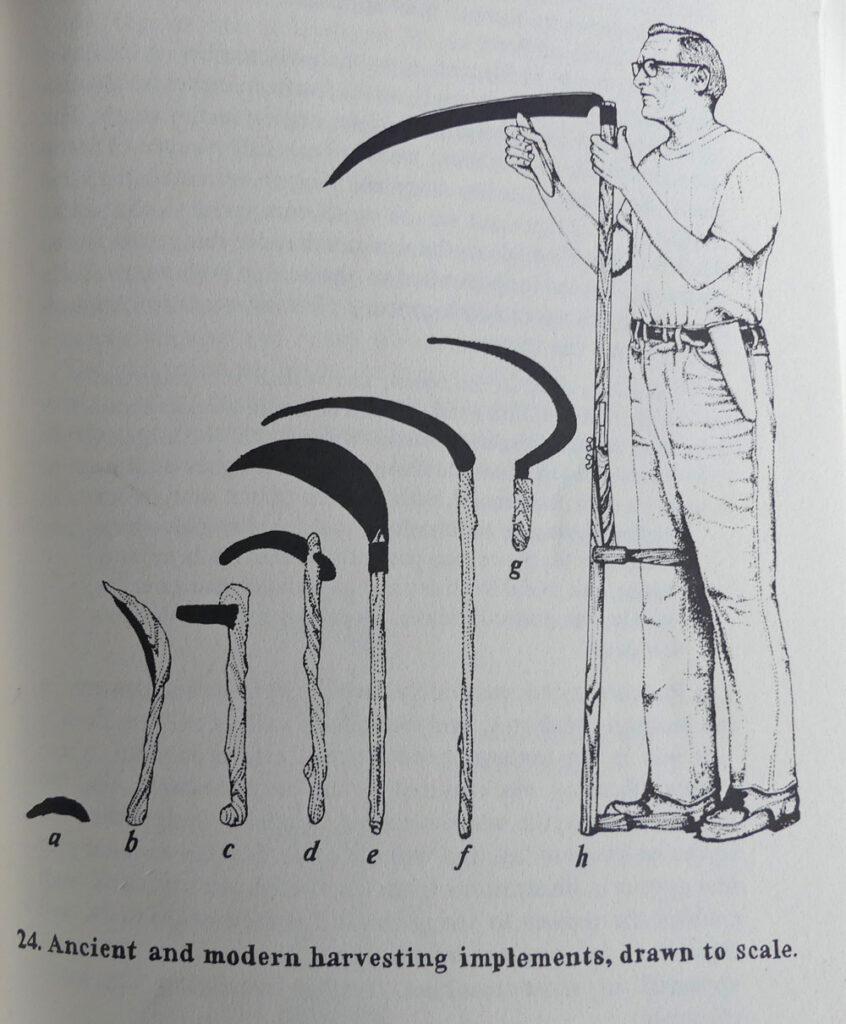

What do you need to mow a meadow?
What I have done is to try the same experiment but trying my historical selection of tools to mow grass for hay.
George Peterken in his book meadows has postulated that it was not practical to cut grass for hay in any useful quantity until the invention of the scythe in Late Iron age/early Roman period. I set out to test this hypothesis for myself in a hands-on experimental archaeology type way.
So what does it take to mow a meadow?
1. Location – a meadow
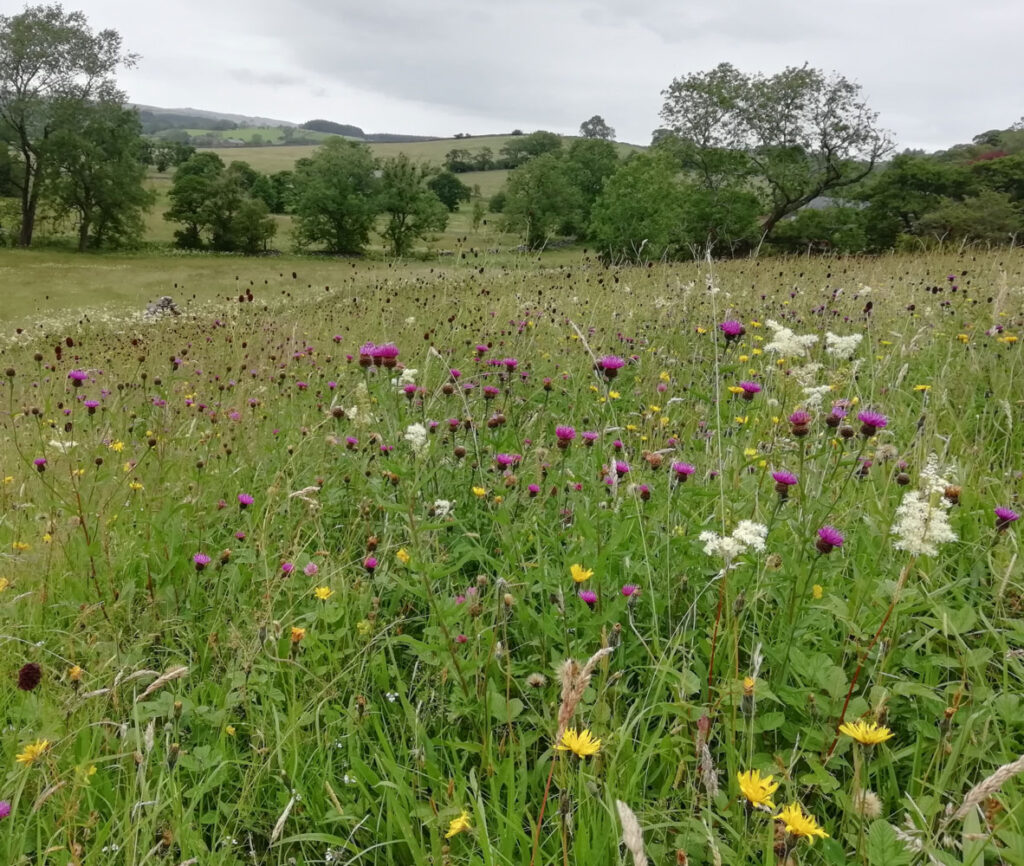
I chose to run my trial at the 2024 Northern Scythe Festival which was held on the Bell Sykes Coronation Meadows, Slaidburn, Forest of Bowland. These SSSI meadows offer species rich grassland which is likely similar in composition and structure to the meadows which developed naturally in response to mowing management by the earliest farmers with scythes. It is also a scyther’s dream being close to perfect to mow and even.
2. Tools – Sickles and Scythes
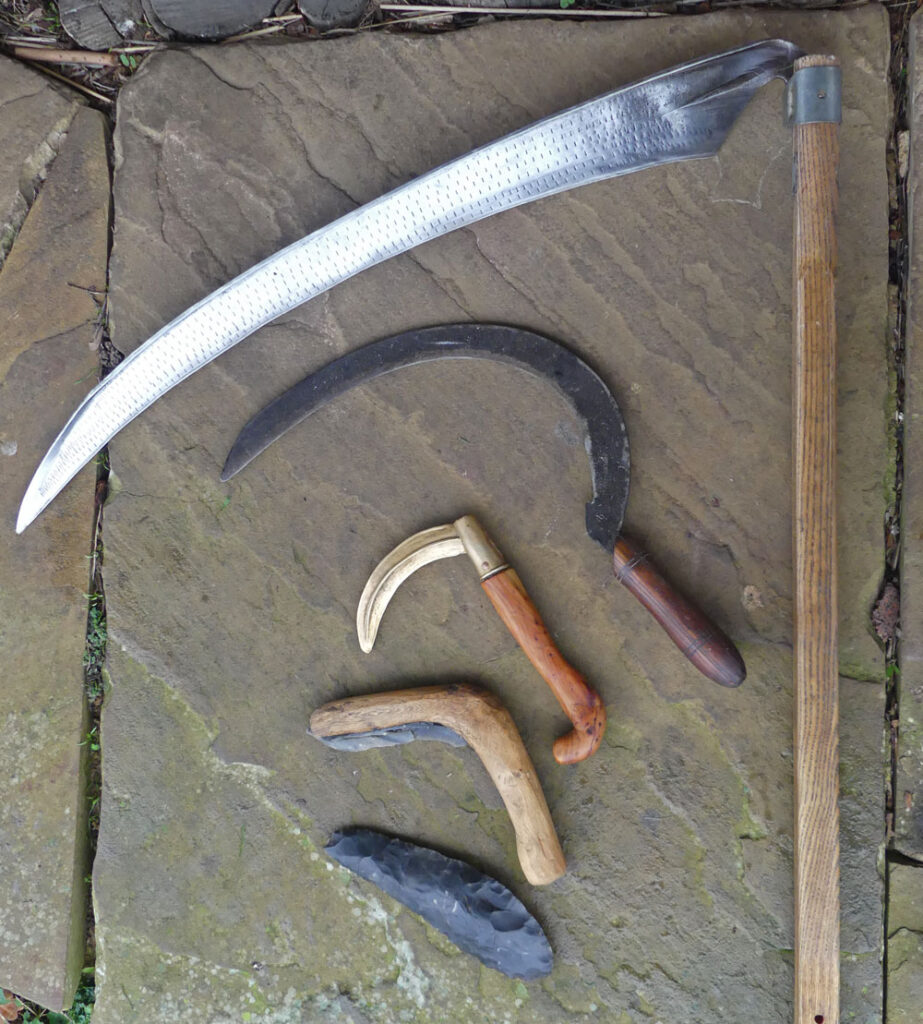
Flint hand sickle. A one-piece flint sickle expertly knapped for me by John Lord. In form it is similar to a flint hand axe. It based on stone age flint sickles, but is not an exact replica on one particular archaeological find. its unique form coming from the way the flint spoke to John as he knapped as would have been the case for craftsmen of pre-history.
Flint hafted sickle I made this tool myself loosely based on different examples seen online. The flint blade is made of two flint flakes knapped from a core (with instruction from John Lord), and set in a wooden handle using pine tar as glue.
Must Farm Sickle This bronze sickle is a replica of one of those found during the Must Farm bronze age excavation. The bronze blade was cast by James Dilley who makes Must Farm replicas for Cambridge Archaeological Unit. I made the handle from Yew based on one found intact on a separate excavation. I peened and honed the sickle edge. The Must Farm site where the sickle was found dates to 850BC in the late bronze age. It represents the pinnacle of sickle design in bronze. For more details on this sickle see my previous post wildscythe.co.uk/bronze-sickle/
Steel Sickle grass hook Once iron and steel were used to make sickles their use and form developed and diverged. Sickles made to harvest corn retained the toothed serrated edge of flint sickles. Sickles made to cut grass have smooth edges without serration. This latter type commonly became known as hooks as opposed to sickles. The tool I selected to represent iron and steel sickles is a grass hook of a 19th/20th century type manufactured by Brades and stamped No2.
Scythes
I mowed two plots with two different scythes during the event’s 5 x 5 m competition
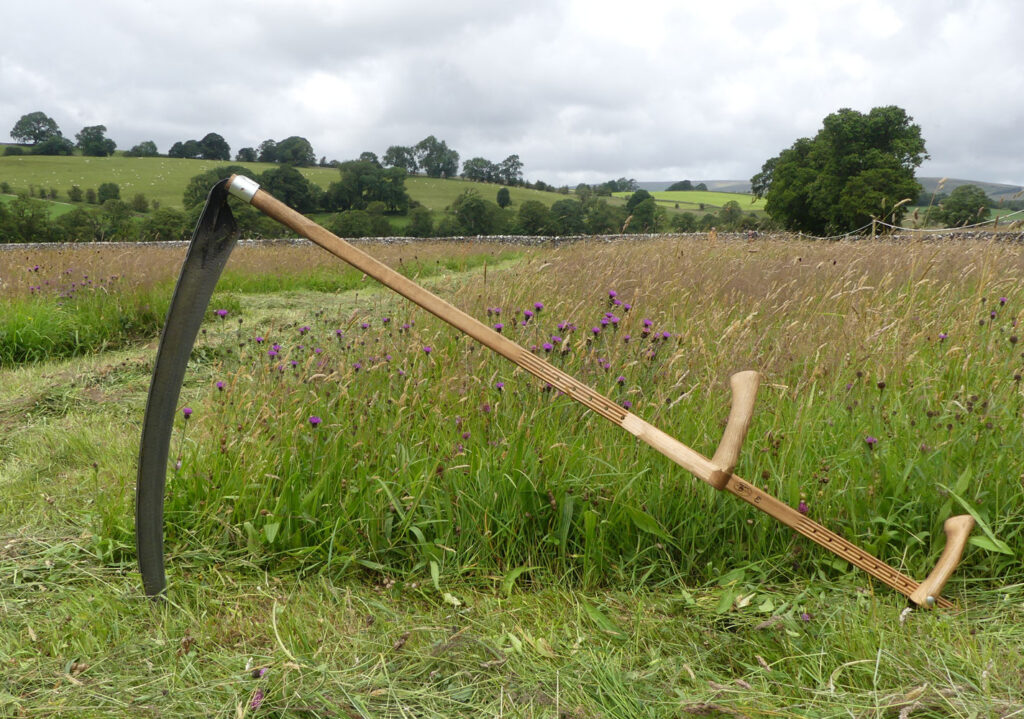
Austrian scythe My regular 21st century Austrian scythe made by Schroekenfux with an 85cm blade. This represents the pinnacle of 2000 years of scythe use and development.
English scythe with a restored vintage 90cm crown blade mounted on a custom snath made by Terry Standen. for more see wildscythe.co.uk/english-scythes/
Bronze sword! Not really a serious part of my trial. As a part of my quest to acquire a replica Must Farm sickle I cast and peened a bronze sword. This has a much longer edge than a bronze sickle and so is closer to that of a scythe.
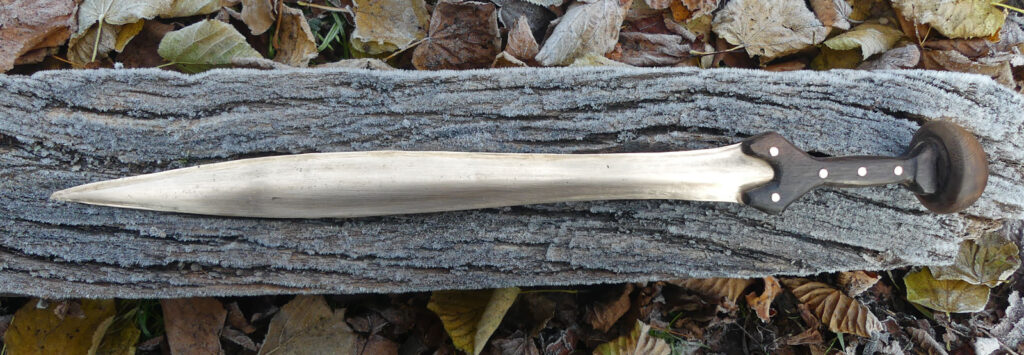
I thought it would be fun to see what might have resulted if a bronze age farmer tried using his sword to cut grass with. It also allowed me to play and learn more with bronze as a material to find its limitations.
Method
With each tool I mowed a measured area. Each plot was big enough that I could get into the feel of using the tool, then mow a timed section that was achievable within a few minutes work. For the two scythes I used my 5 x 5 m (25m2) competition plot scores which took less time than mowing just 1m2 with a sickle.
Results
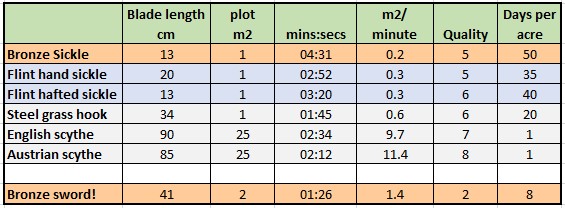
The ‘days to cut one acre’ figures above are my estimates extrapolated from my small plot trials, then standardised to the received wisdom that a man should be able to mow one acre in one day.
The results in the above table speak for themselves. Sickles are indeed hopelessly inefficient tools for cutting any useful amount grass. Not really a surprise as whist sickles were probably handy general-purpose cutting tools, they were never really intended for harvesting bulk hay crops.
Size matters.
The length of blade possible with flint or bronze is a major block to developing a scythe for mowing grass. The longer the blade the more you can mow.
Sharpness essential
The fresh edge on a flint blade is really sharp: at least as sharp as a freshly honed steel scythe blade. The hand sickle has a reworked edge and is serrated. The flint flakes each have smooth edges and a finer taper. A flint will hold its edge longer than steel but will dull with extended periods of use.
You cannot hone a flint. If you have knapping skills you can rework the edge of the hand sickle a number of times. The flint flake sections in the hafted sickle can be replaced.
With bronze by both peening and honing I was able to produce a reasonable cutting edge. This edge was however never as keen as a flint or modern steel edge, and even with the work hardening from peening, the softness of bronze meant it would not hold its edge for very long at all. The Must Farm sickle could cut fairly well initially but needed frequent honing to keep cutting.
My bronze sword was faster than a sickle but crap. Essentially it had the wrong sort of curves so I could only haft it in a way that a portion of the 41cm edge presented to the grass at an effective cutting angle.
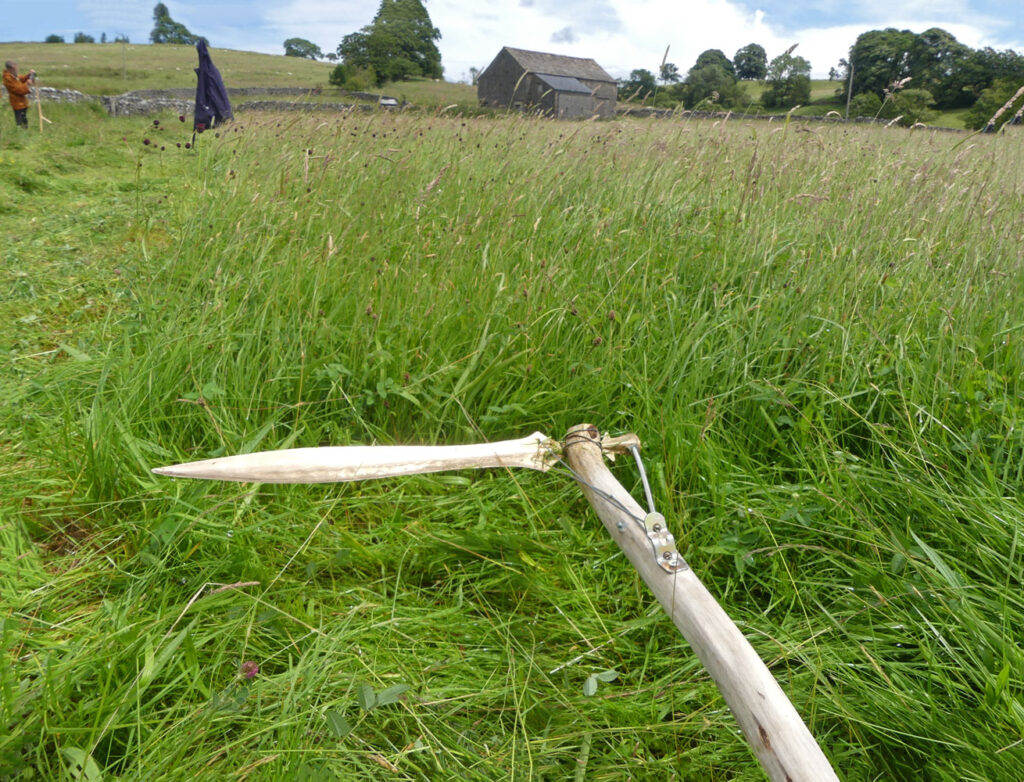
The softer bronze would not support such a fine taper to the edge as is possible with the best steel. This is particularly true of the sword which as a weapon needs to have a thicker cross section. The bronze sword blade in spite of its thickness is easily bent. I braced it with bike spokes as best I could when hafting it to a snath, but I doubt it would survive long in the field. From what I have read, I suspect bronze swords were single use weapon, or at least a single serious engagement weapon. The likely serious damage and distortion as might follow contact in combat could make it easier to recast than repair. The majority of bronze sickle and sword finds come from scrap hoards of worn and damage items cut up ready for re-smelting.
Conclusion
All this lends weight to the idea that cutting grass to make hay only really became a practical proposition following the invention of iron and steel.
There are documents that reference meadows in the Yorkshire Dales as being so many days mowing. A customary acre in the Yorkshire Dales was much greater in area than the one in general use from the nineteenth century. A customary acre in the Dales is more or less 1.6 modern acres.
Where does the popular notion that mowing with a scythe one day equates to mowing 1 acre of meadow, and is that based on the older customary acre or a modern acre?
Once person mowing 1.6 modern acres of meadow in a day with a scythe seems a tall order. It would be useful to check the areas of those meadows documented as being so many days mowing in the eighteenth century.
Tom, yes it is just a ‘popular notion’ I am not sure of its basis in fact or historical accounts. Most of the written accounts I have read refer to mowing corn not grass.
Your Dales accounts sound like an intriguing way to put some estimates on it if you can reconcile parcels of land, actual size and days to mow.
At that Northern Scythe Event in 2024 (where I did these trials) 18 mowers mowed one acre in 45 minutes as a team.
That equates to 13.5 hours per person per acre – not a bad approximation for a laid back team of variable proficiency and stamina.
My own sprint speed over just 25m2 actually extrapolates to one acre in six hours – which of course I haven’t the stamina to sustain for an acre! But fit gang mowers of the past would.