
In at the deep end – Sub aqua scything – the next level
This autumn (2025) I was asked to deliver a scythe course to a group of professional landscape contractors tasked with managing and cutting vegetation along river systems by hand in areas inaccessible to machinery.
I have previous experience of wetland management with scythes: reed cutting here in Norfolk, ditch clearance in Broadland using a long-reach maig, bank mowing with Fenland Internal Drainage Board workers, and Himalayan Balsam control.
This particular brief however took sub aqua scything to the next level for me. Most of my previous experience involved mowing the Riparian zones: the banks and wetland adjacent to the water course, not working in the river itself!

I knew that I was to be provided with waders and a life jacket; the contractors (VMS Ltd) being very professional and thorough with H&S and PPE. It was only on my arrival to the site and reconnoitring the mowing potential that I got to ask the guys on the ground where was the main area they were wanting to mow?. They pointed to stands of tall vegetation growing out in the middle of the Great Ouse river (behind us in photo above). “And how deep is it there?” I asked tentatively. “About waist deep they indicated on their deep waders. I knew then that the day would be interesting!
I was however sure from the start that we would have a productive session. I was confident in the scythe’s adaptability to all manner of tasks and situations. I have previously supplied scythes to people for harvesting rushes from rivers for weaving. The guys in the hand-work team were very professional and used to working in this environment and using hand tools.
We started the session as usual, familiarising the team with the scythe, correct set-up, movement and sharpening. Initial instruction and practice took place on dry ground on the river banks. From this the guys learnt that scythes are ideal (better than their brush cutters) for grassland on banks too!

In at the deep end
In the afternoon we all kitted up in wet gear and transferred into the river itself.
I ventured ahead to test things out, this being my first experience of mowing aquatics waist deep in water.
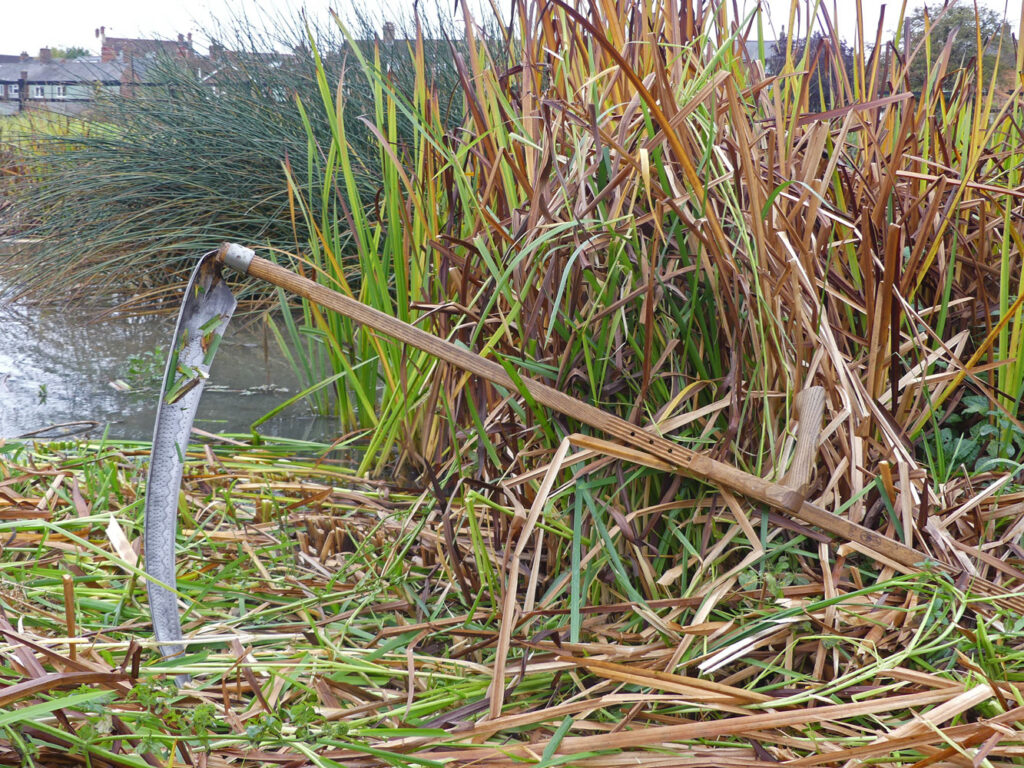
The plant vegetation was mainly stands of tall sedges (Carex riparia) and some bulrush. I was pleased to find both were very succulent and yielded easily to the scythe, and much easier to cut than tough Norfolk reed (Phragmites) stems.

The subaqua-scything could be organised in swaths focusing on the usual slicing action. The main obvious difference was that the scythe was submerged below the lower grip, and so when moving under water, the resistance of the water against the scythe, plus heavy drag from the cut stems, made mowing in complete arcs impossible. Instead, each cutting arc would need to be more a series of short slicing movements working from right to left.
Keeping the blade close to the ground (riverbed) was not essential here, either functionally (the mass of the plants was held in place by the water so did not fold over if cut higher), nor was this required to meet the objectives of this particular task which was to remove most of the above ground vegetation to clear the water enough to no longer impede water flow in the channel. This differs from reed clearance with a maig in drainage channels on Broadland where the aim is to undercut the rhizome mat to set back its recovery as much as possible.

Aqua- swaths!
We still organised cutting in sections, in aqua-swaths! With the cut material deposited to the left into a previously cut and cleared open water zone (swath).
I cannot describe this as being deposited in ‘wind-rows’ as the material floated off as ‘water-rafts’. These water-rafts were easily guided immediately to shore by coworkers with forks before they could float away downstream in the steady current. Some discussion followed as to the best working pattern of aqua-swaths to take advantage of the water flow to aid clearance but avoid losing material downstream.
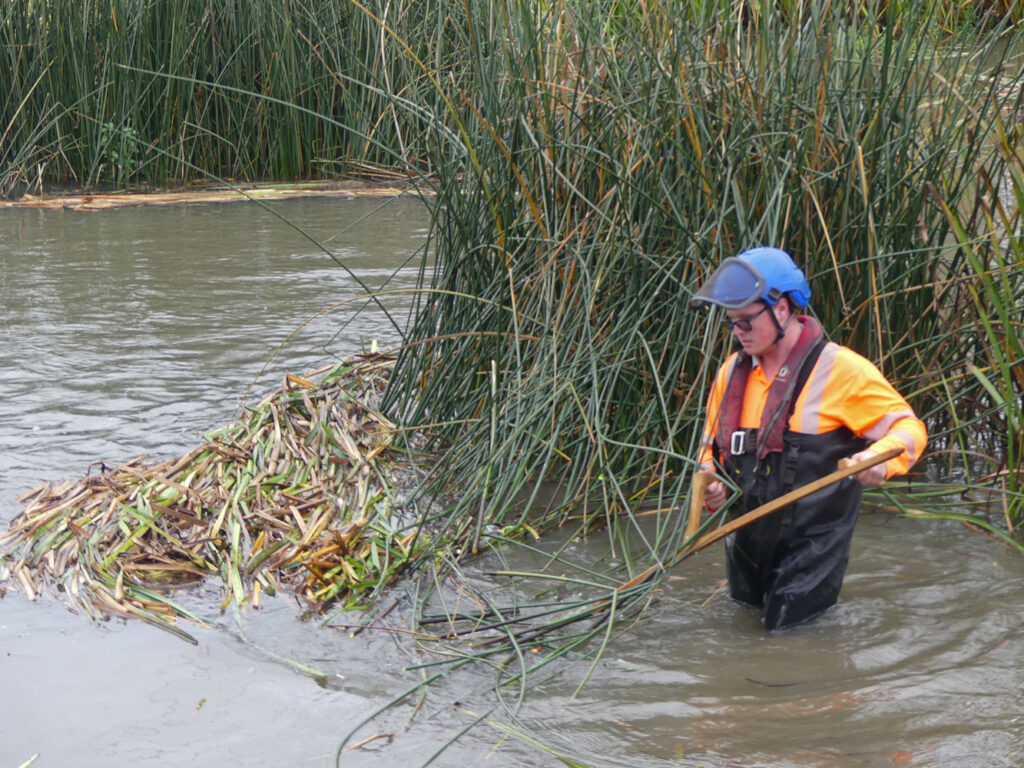
Even as newcomers to scything the team were very soon impressed by the potential of the scythe for the task as straight away it proved so much better than what they had attempted previously with powered equipment. After a call to head office scythes were purchased for the team. One of the workers even purchasing his own personal scythe to ensure he had access and control over it for future tasks.
A variety of blade types and lengths were tried during the session. They settled on the 65cm Styria ‘ditch’ blades as best for the task, with an interest in 75cm grass blades if they later switch to scythes instead of brush cutters for bank work.
Scythe benefits summary
HAVS In practice just one of the many benefits of adopting the scythe was the deciding factor. That factor is HAVS (Hand-Arm Vibration Syndrome – see also footnote below).
In truth all I had to do was to demonstrate with the team that a [zero HAV] scythe could do the job, and the switch to scythes was assured.
Previously the hand-work team had been using 2 stroke petrol powered long reach hedge trimmers with reciprocating cutter blades – underwater! This was simply unsustainable on HAV criteria alone. This had been revealed by Risk assessments and confirmed by vibration monitoring of workers in the field (river).
Essentially using a petrol hedge trimmer a worker can be expected to exceed their maximum daily Vibration exposure limit after only 2- 3 hours cutting, not even a half a day’s shift of effective operational time.
This is without the many other benefits of scythes over power tools which they listed as
Efficiency: Scythes proved more efficient (faster) than hedge trimmers in this task, and potentially at least as quick as brush cutters for land work. Factor in restricted daily HAV hours for a machine, then the scythe is way more efficient being able to work a full shift.
User comfort and stress. Both hedge trimmers and brush cutter are physically awkward and tiring to operate. Apart from the HAVS issue they are heavy and noisy.
Maintenance and cost: Oddly enough hedge trimmers are not designed or suited to working underwater! Water penetrating the final gear housing mixes with the grease. This and other wear from use in a river significantly reduces the life of the cutting head which as a spare part cost over £300 -twice the cost of a full scythe kit.
Hedge trimmer blades need regular sharpening. This for their zig-zag overlapping knives is a tricky operation taking 30 -40 minutes in a workshop. This compared to seconds for scythe whetstone honing in the field and occasional peening.
In addition, powered machinery needs regular re-fuelling and servicing of the engine and moving parts especially the compromised gearboxes as mentioned above.
Environmental pollution. River systems are especially sensitive to pollution. Full environmental risk assessments have to be undertaken before taking a petrol engine equipment anywhere near a watercourse. The risk of contamination of the water with fuel and oil is obviously very high when actually working in the river. Refuelling is also risky even if correctly done well away from the water. In addition, fumes and noise pollute or disturb the environment.
Working Convenience. By definition this type of hand work on river systems is often in areas that are inaccessible for vehicles and machinery. All equipment will need to be carried to site. In addition to the heavy hedge trimmer or brush cutter itself, fuel will need to be transported together with required spill kits and mats, and will need a separate safe refuelling place set up away from the river.
To operate a scythe by comparison just needs the light weight scythe with its whetstone and a packed lunch for refuelling.
It was no contest really the team just needed training and reassurance that the scythe could deliver
Postscript: Scythe vs Machine
Whilst we were working our section of the river with scythes, by chance, just 100m or so upstream of us above a weir was the Environment Agency doing the exact same clearance job but with high-tech, almost sci-fi amphibious tracked machines. There were two machines operating together: one cutting with a reciprocating knife (like a hedge trimmer but designed for use in water), the other clearing cut material to the banks with a grab fork attachment.
These machines were fascinating to watch, like giant very expensive toys. Their actual performance on the task was less than impressive given the technology being deployed.


Looking at what we had achieved with the scythes in a comparatively short time, the work team felt that given a full day working they could have delivered a similar or even a better result.

The machines did not move quickly through the vegetation and appeared to work back and forth repeatedly over the same section. It was not as one might imagine anything like a combine harvester devouring a field of wheat, or a tractor mounted mower cutting grass.
What really dragged down their daily work rate was not the slow operating speed (undoubtably still higher than a scythe) but the fact that they could only operate for short periods and spent long periods of the working day sat idle on the river bank. The reason for this was apparently that their very whooshy track propulsion stirred up river sediment releasing silt, methane and CO2 into the river, which in turn could kill fish and other wildlife. As a result, they were forced to work intermittently.
Furthermore, repeat machine cutting the same spots resulted in lots of short loose stem fragments which the amphibious grab rake missed and which then floated away downstream. This was a bit annoying for our downstream scythe team as this loose debris arrived over the weir into our work area. (see bulrush photo above). This was not just about tidiness as the job required the cut material removing from the river, and the EA who were creating the mess would be the same commissioning body that could audit the work quality in our section.
Footnote
Hand-arm vibration (HAV)
Hand-arm vibration from operating hand-held power tools can cause a range of conditions collectively known as hand-arm vibration syndrome (HAVS). Vibration causes permanent damage to nerves, blood vessels, muscles and joints of the hand. The signs and symptoms include numbness, pain, and blanching (turning pale and ashen), and can lead to specific diseases such as white finger or Raynaud’s syndrome, carpel tunnel syndrome and tendinitis. A loss of dexterity and feeling in the hands will occur, meaning everyday tasks such as doing up buttons will become difficult. HAVS can reduce quality of life, for example, sports and hobbies like darts. golf, DIY or gardening become challenging or almost impossible.
Workers using power tools in their jobs as are particularly at risk because of the increased ‘trigger times’ they are exposed to with the pressure to ‘get the job done’.
There are two HAVS exposure limits defined in the Control of Vibration at Work Regulations. These are legal limits for the amount of vibration a worker can be in contact with daily.
The limits are the Exposure Action Valve (EAV) medium risk; and Exposure Limit Value (ELV) High Risk.
Brush Cutter 2 stroke: 2.5m/s2; EAV 5 hours ,max ELV 12 hours
Hedge trimmer 2 stroke: 8m/s2; EAV 1 hour; max ELV 4 hours
Scythe no limits!
Thanks to
Big thanks to the VMS team at or inviting me to deliver this scythe training and spend a great day “messing about” in the river. VMS Ltd are one of the UKs Leading De-Vegetation Contractors in Rail, on Water and in Commercial Spaces.