
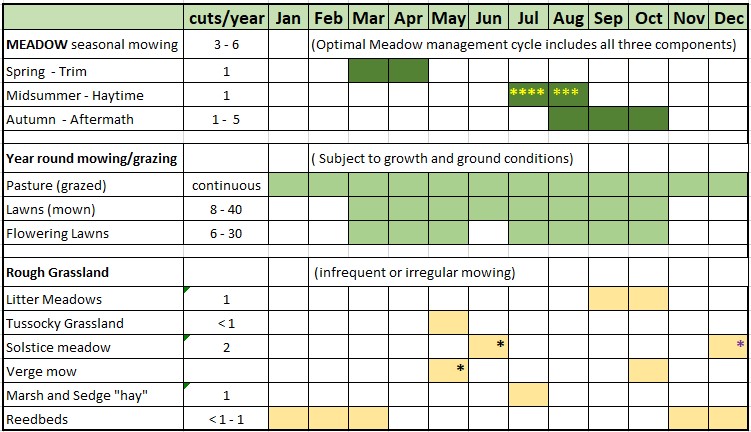
A quick guide as to what to mow when using your scythe through the year

NOTES
Most mowing cycles have seasons of cutting rather than a specific date. The *asterisks in Midsummer haytime for example indicate more than one Mowsaic cutting event for different sections of the meadow spread over the season.
MEADOW
A Meadow specifically comprises a regular cycle of management synchronised to the seasons and growth patterns of plants. Importantly it includes cutting and removing the peak biomass each summer as hay.
Meadow management potentially delivers the most diverse grassland.
Optimal Meadow management includes all three seasonal components
Spring – Trim Lush growth cut and remove cuttings round Easter depending on growth and cowslips see Equinox spring clean
Summer – Haytime Main cuts staggered across the field over the season July (peak) and August see wildscythe.co.uk/haytime/
Autumn – Aftermath Regular grazing or mowing of regrowth – or – one or two mowings removing cuttings. Aim to leave the sward short (50-75mm) by October/November see wildscythe.co.uk/autumn-mowing/
Short Turf
Year-round continuous grazing or mowing produces a short tight sward in which only the most grazing tolerant species thrive
Pasture (grazed) May or may not be year round depending on growth and winter conditions for livestock.
Lawns (mown) – includes mown pathways and sitting areas
Flowering Lawns I find that resting my lawn from cutting in late May/June for 6-8 weeks works best (mowing through most of May)
Rough Grassland
Irregularly or infrequently cut grassland produces a different vegetation structure to more intensively managed meadows, pasture and lawns.. Whilst generally of lower plant diversity dominated by more robust tall herbs and grasses, it is itself a valuable habitat resource as part of a mosaic of linked habitats.
Litter Meadows Late cut grassland for bedding only, as the hay quality is very poor, as is resulting plant diversity
Tussocky Grassland I suggest a May cut timed after overwintering insects using it have emerged and moved into the meadow. An early summer cut allows time for it to regrow for next winter. Cutting is mainly to restrict scrub and bramble encroachment so may not needed every year depending on site.
Solstice meadow A specific annual cut cycle I use to encourage cranesbill and other tall herbs
Verge mow To fit with road sight-line maintenance. Favours dandelion and white deadnettle good sources of early pollen and nectar.
Reedbeds Winter cut every year or every other year, for thatching reed; or in 7 year rotation for wildlife see wildscythe.co.uk/reed-cutting/
Marsh and Sedge Fen Sedges traditionally cut in July for thatching, Marsh hay also cut in July as feed, or later as litter hay.
“Weeds”
Himalayan Balsam Cut down before any balsam seed set (by July ). Revisit site later to mop up any survivors.
Giant Hogweed Wear full body and face PPE cover. Cut down in full flower and no seed set (June). Revisit to mop up survivors.
Cow Parsley Cut back end of May before seed set and dispersal to prevent it spreading
Perennial weeds Manage as a meadow to constrain weed vigour. Lax (not too short) autumn aftermath grazing or mowing
Bracken Cutting helps to control bracken but eradication may need cutting combined with rolling or trampling by cattle.