

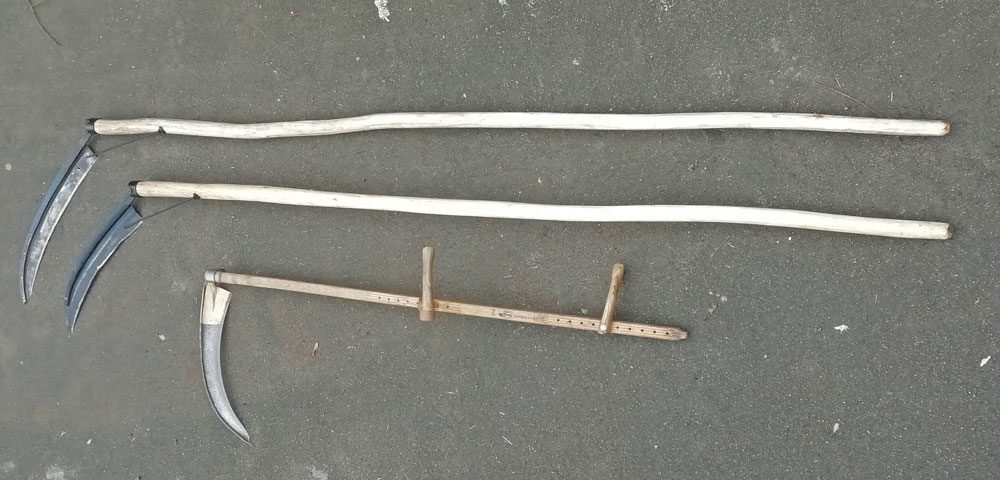
Maigs are a traditional long reach scythe – used in the Norfolk broads for clearing emergent vegetation in drainage ditches from the bankside. They are also useful for clearing excess growth from the margins of ponds and other water features.
Working with the Norfolk Wildlife Trust has given me the opportunity to try these tools for myself. I have since made two Maigs for use on wetland reserves in Norfolk and Suffolk.
As a result of this I have put together two videos on Maigs.
For further written description of the use of maigs – read on
Practical applications
Maigs, like regular scythes in meadows, offer the capability to effectively manage small to medium sized areas of wetland in a particular focused way that can deliver results that cannot be achieved by other means.
A good network of maintained drainage channels, of grips, ditches, dykes, cuts and rivers are important features of managed wetlands. These channels function to both feed in and distribute flood water, and to drain down marshes and fens when required for maintenance and reed cutting. Periodic clearing of ‘weed’ colonising and eventually choking channels is a key part of this.
Whilst most of the semi-natural wetland that remains is managed principally for wildlife, rather than agriculture or commercial reed production, the management of water levels and seasonal cycles of vegetation cutting remain important as this determines the particular vegetation and habitat composition that develops, and the diversity of wildlife it supports. Water management in wetlands is also important for flood management in the wider landscape.
Maigs and other scythes offer the potential to implement very focused sensitive management where this is appropriate. They are invaluable for conserving remnant fragments of wetland with particularly high botanical and wildlife interest which historically developed from traditional cycles of management.
Machines are often not efficient in small and difficult to access sites. Machinery can clear large areas quickly but lack the finesse of hand tools. Mechanical excavators may bring other other problems such as ground compaction, and potentially compromised biosecurity by inadvertently transferring invasive alien plants and animals from one site to another. Hand powered tools of course avoid the issue of noise and other pollution and are more compatible for use within volunteer groups.
Technique
The Maig is used to cut emergent reeds and other ditch vegetation encroaching into the ditch from the sides. It is set up to undercut both shoots and rhizomes, to deplete remove as much of the plant’s growth as possible.

The maig is not swung in an arc around the body like a regular scythe. The Maig is worked towards the operator stood on the bankside by pulling in the snath in a series of short slicing/sawing movements. The open hafting angle facilitates slicing.
As with regular scythes, if the blade is sharp, and the right technique applied, it should not require excessive force or exertion to work steadily and methodically across the ditch. In fact, if you pull too enthusiastically and it snags, you are likely to pull yourself into the ditch!
Cut material severed by the maig needs to be removed from the water channel.
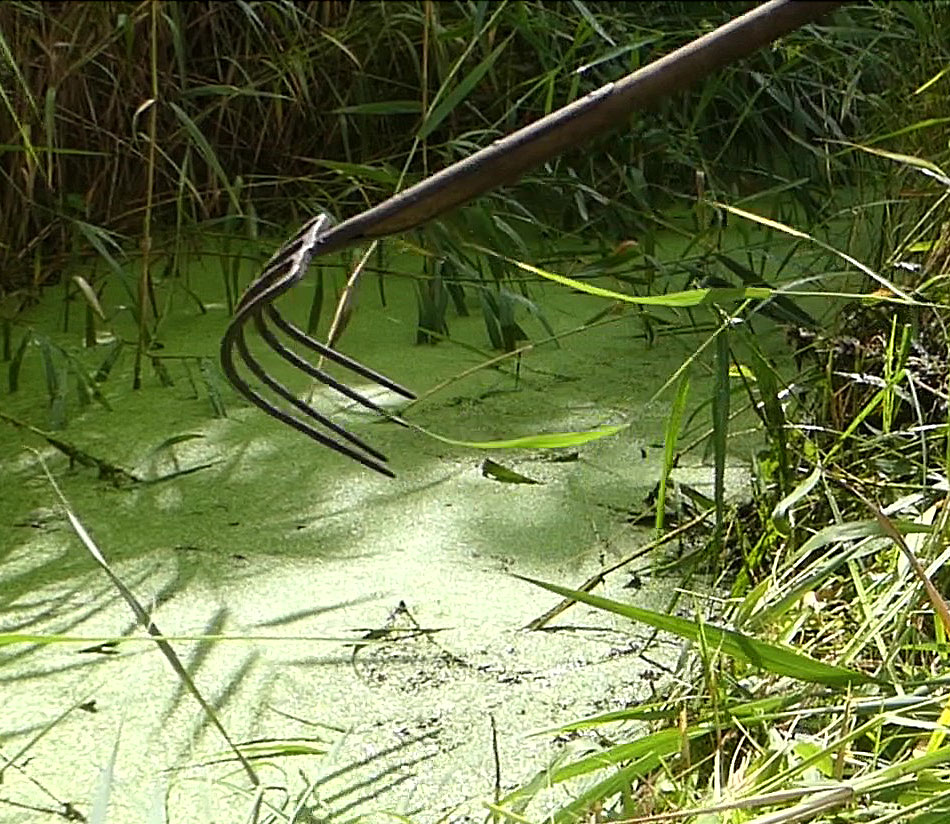
The cut material can be deposited on the bank side to allow water to drain from it, and give wildlife caught within it a chance return to the water. The material can be collected some days later and removed to a dump site to avoid compromising the bankside vegetation from the mulching effect of rotting piles of vegetation and by concentrating unwanted nutrients here.
The best practice for the benefit of wildlife is to aim to clear at most 50% of the wetland vegetation in any one season. This can be achieved by clearing short sections, and leaving other sections, or, in larger channels, by clearing one side only in each year. This rotational cutting cycle creates a dynamic mosaic of different habitat structures: from open clear water and trimmed bankside vegetation, to overgrown channels surrounded by taller vegetation. Each offers different habitat opportunities, so overall the mixed structure can support the widest diversity of wildlife. Maigs and scythes are clearly well suited to creating this variety on quite a small scale.
For a longer more detailed version of this account, including a description of making and using Maigs go to http://scytheassociation.org/maig-the-sub-aqua-scythe/
Dear Mr Brown, Thank you for your thorough description of technique. I am wondering if a maig may suit our circumstance. We have a 90’ x 45’ Sussex marl pit pond. Round the sides, and each year encroaching toward the middle, a lot of ‘flags’ grow – I’m not sure of the technical name but they must be the height of the reeds in your ditch photos, but fleshier I’d say and have yellow flowers later in the year. Like your reeds they spread by rhizomes under the pond bed.
Would you think the maig blade and technique suited to such plants?
If so where might I buy a maig?
I guess I would need the longest shaft to reach as far as possible, bearing in mind your advice not fall in! What might that be and how long? If it makes any difference, I am 6’4”.
Willows grow all round this boggy clay countryside. We could look for a suitable branch to suit the dimensions of the blade socket etc, which you so usefully gave. But If the whole thing can be bought it would save time as my skills in that direction are not great.
Incidentally what is the meaning of a “snath shaft”. Perhaps you just meant they are interchangeable or perhaps ‘snath’ adds a meaning as opposed to just a shaft ! Maybe it comes from the word ‘snatch’? The motion looked a bit like a snatch.
Thank you so much for your time.
Nicholas
The Maig can deal with a range of pond edge plants. Reeds can be quite tough, whereas fleshy rhizomes like Reedmace, bulrush and Flag Iris are probably easier if anything.
Snath is the traditional word for a complete scythe handle and grips. The word is related to snedding = lopping branches from a tree or coppice – from which you might acquire a suitable scythe pole.
I use shaft or pole to describe the main part of the snath (minus grips and fittings) and for those not familiar with snath. Maigs don’t have grips so pole is probably a better descriptor.
The poles I fit to Maigs are generally 9 feet long or a bit more. Long enough to clear a ditch and short enough to fit in my car for transport.
I have heard of poles up to 14 feet long being used. There must be a point where they become too unwieldy to handle.
I think Maigs were always custom made to order by a local blacksmith as a conversion from an English scythe. This is what I have been doing repurposing vintage scythe blades and fittings.
I have made and sold several Maigs this winter. I have enough parts to make another but do not have unlimited supplies of knackered English scythes to cannibalise. Email me if you are interested.
The poles are too long to send by courier, but not hard to make on site from straighish poles cut (sned) from the hedgerow (much easier than making a regular scythe snath)
Some folk build their own from an old scythe found online (FB marketplace).