

The subject of this post is to review whether harrowing is a necessary and useful practice; particularly in the context of grassland managed principally for its wild flowers and wildlife benefits?
I will review what benefits harrowing can bring to the function and diversity of a meadow, and consider if there unintended side effects from this disruption, for example to ant colonies or grassland fungi networks?
Why Harrow?
Harrowing and scarification have long been a regular feature of grassland management. Harrowing for agricultural meadows and pastures (traditionally with chain harrows), and scarification with lawn rakes or machines, for amenity lawns and sports turf.
The two main reasons given for harrowing are:
- Smoothing and levelling the meadow surface to reduce high spots such as mole and ant hills, and fill low spots and ruts.
- Clear out moss and dead trash/thatch clogging the base of the sward.
Other benefits claimed include
- Opening up the soil surface to let oxygen get to the roots
- Spreading of animal droppings
- Drag out shallow-rooted weeds like chickweed and annual meadow grass.
- Breaking up mat forming grasses and weeds
- Release locked-up surface nitrogen to the growing grass.
Which of these claimed benefits harrowing actually delivers has long been open to question. There has always been an element of following fashion, of being seen to produce the right stripes in pastures in spring. Traditional chain harrows have long been consigned to nettlebeds on farms as an obsolete practice, but there is a more recent trend for tractor mounted spring tined grass rakes, for which, all the old benefits are re-listed by their manufacturers.
Levelling up
I do find it useful to harrow my meadow to level the surface periodically to take out mole and ant hills that have built up through the season. This helps produce a better mowing surface less prone to scalping the grass, snagging soil and blunting my blade. I try to knock down and spread the soil from molehills with a rake or my boot as they appear through the year, but there is always some I miss whilst the meadow is in full growth.
Agriculturally, harrowing is traditionally followed by rolling to push stones back into the ground to prevent issues with mowing, and to crush soil clods to minimise soil contamination of silage and hay. My soil is stoneless and clods soon melt away with the rain, so I do not face these issues.
Creating gaps
The main reason I harrow my meadow is to open up the sward. I am looking to create gaps into which yellow rattle and other desirable wild flowers can gain a new foothold, to provide the essential space for seeds to germinate and grow into. Harrowing will remove inhibiting layers of moss and thatch, expose the soil creating a tilth, and tear gaps in the herbage along the path of the harrow tines.
Research trials have shown that to be effective the harrowing needs to be quite severe; it must create sufficient lasting gaps for success with yellow rattle and other seeds. Harrowing needs to expose up to 50% bare ground. Success with no disturbance, or just a light comb-over, is likely to be minimal.


I use quite a heavy harrow with sharp forward facing tine points, and harrow at least twice in crossed directions. How severely I treat my sward will depend on how much I feel I need to create gaps to boost diversity as opposed to just levelling the ground. It is surprising how quickly disturbed grassland will recover and gaps close in.
A traditionally managed meadow would be grazed by cattle and sheep in the late summer and autumn. The action of their hooves, and local overgrazing (poaching) is enough to create gaps. In common with many amenity wild life meadows, I do not have livestock to do this task for me so harrowing in large part is to replace this ecological function.
Timing and ground conditions
Traditionally pastures and meadows are harrowed and rolled in the spring to level them up and scratch out ‘weed’ seedlings and moss that may have accumulated over winter.
I prefer to harrow in autumn as my main objective is to create gaps which will be there as early spring germination sites. I do not really want to risk harrowing in spring as I may pull out yellow rattle and wildflower seedlings that I am aiming to encourage.
Harrowing is best done when there is some moisture in the surface of the soil so that the tines can bite and move soil, but before the ground becomes wet and saturated at depth. If too wet the soil will just smear and its structure damaged. Wet soft ground will not carry the weight of a machine without compaction and ruts forming.
In practice on my ground I find I can usually harrow between September and the end of October. The cut off date depending on when the weather closes in and ground water reaches field capacity for winter. Later harrowing leaves gaps that stay open longer as the grass has less time to recover, but leaving it late means taking a chance with the weather.
Downsides and possible negative effects of harrowing
Anthills
Anthills, like mole hills, are much cursed by scythers at haytime; they blunt blades and soil can contaminate hay. Levelling is the answer in meadows, but people sometimes worry about damaging ant colonies.
There are two main mound forming ant species you may come across.
The common black ant, which in the summer can form impressive termite like towers of soil supported by grass stem scaffolding. These are only ephemeral seasonal structures, the main colony will live below ground – so no great problem levelling these. I do tend to mow around the best ones so they can complete their function (and avoid getting soil in my hay), then level them out when they collapse later in the season.
Yellow meadow ants are the ones that create the impressive permanent ant mounds. Their mounds are often quite ancient and can develop their own special micro climate and flora with species like wild thyme growing on them. These ancient mounds are almost always a feature of grazed pasture and downland where animals will graze around them. Such ant mounds are not generally a feature of meadows which are mown for hay and harrowed each year. To a large extent in meadows a conflict between scythes, harrowing and yellow meadow ants does not arise. The rare exception is where people look to start managing ant mound pastures by scythe as a substitute for grazing, where clearly harrowing would be totally inappropriate.

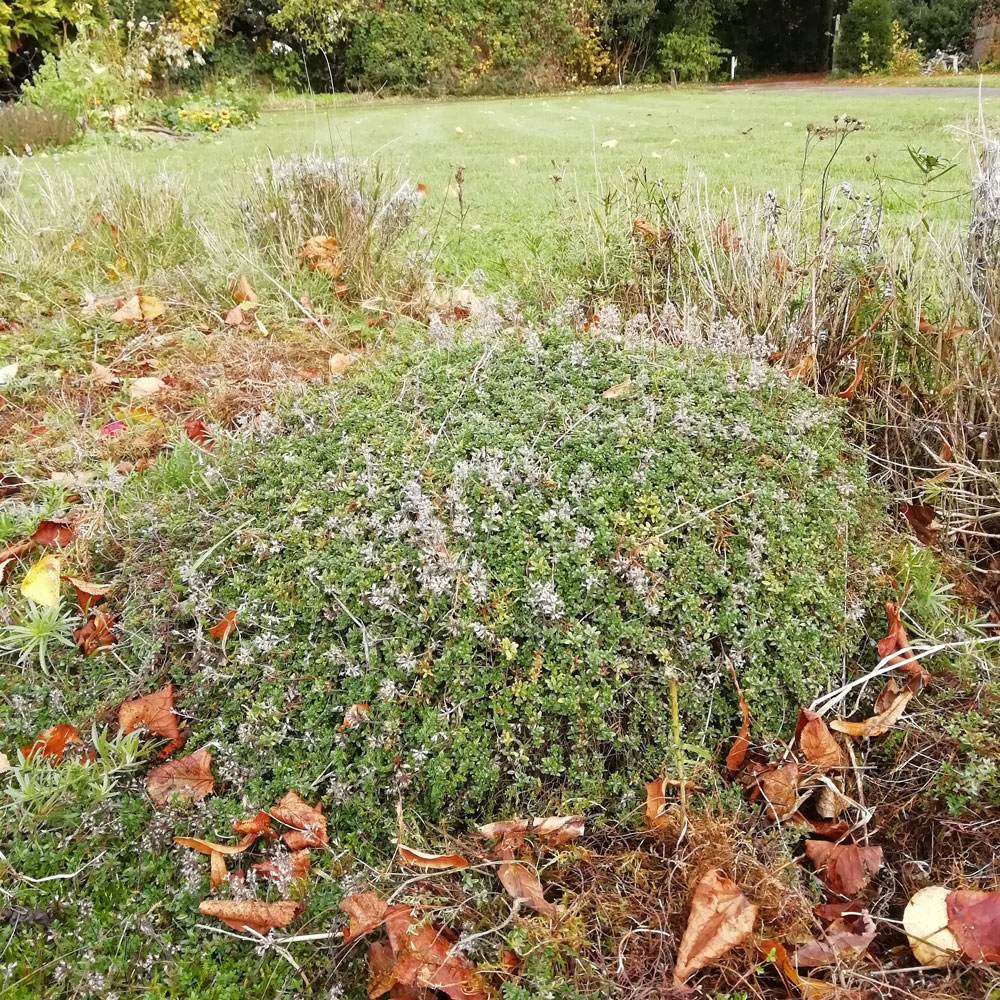
Grassland fungi
I have read advice against harrowing to prevent possible damage to important grassland fungi such as the charismatic waxcap fungi. I would like to avoid this possibility if I can, so have looked into this in more depth in published research and by speaking with researchers in the field.
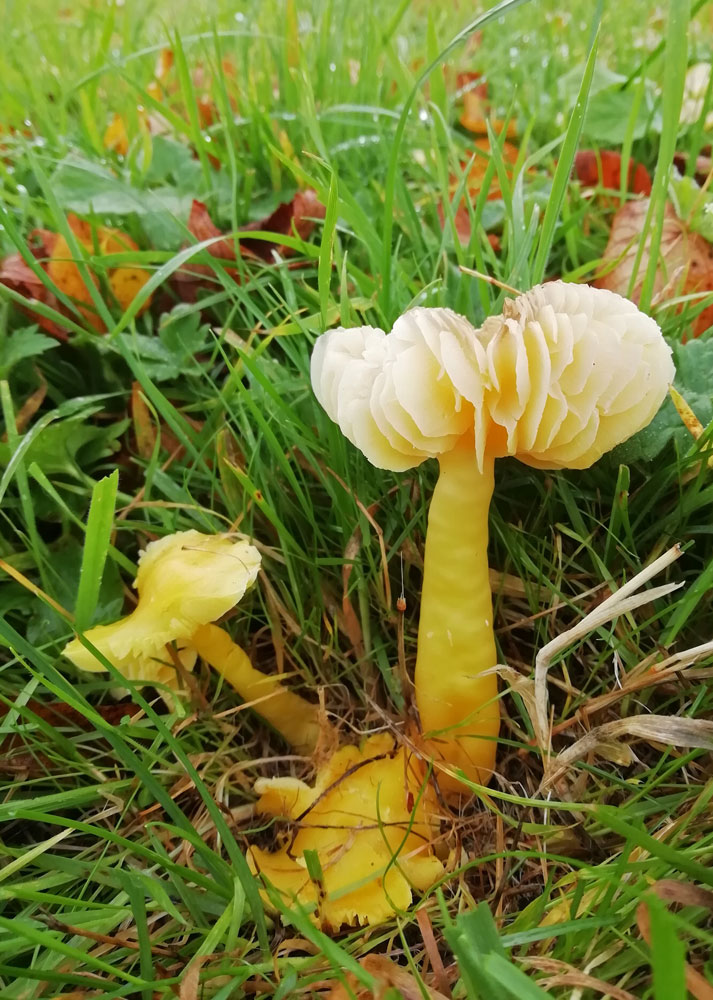
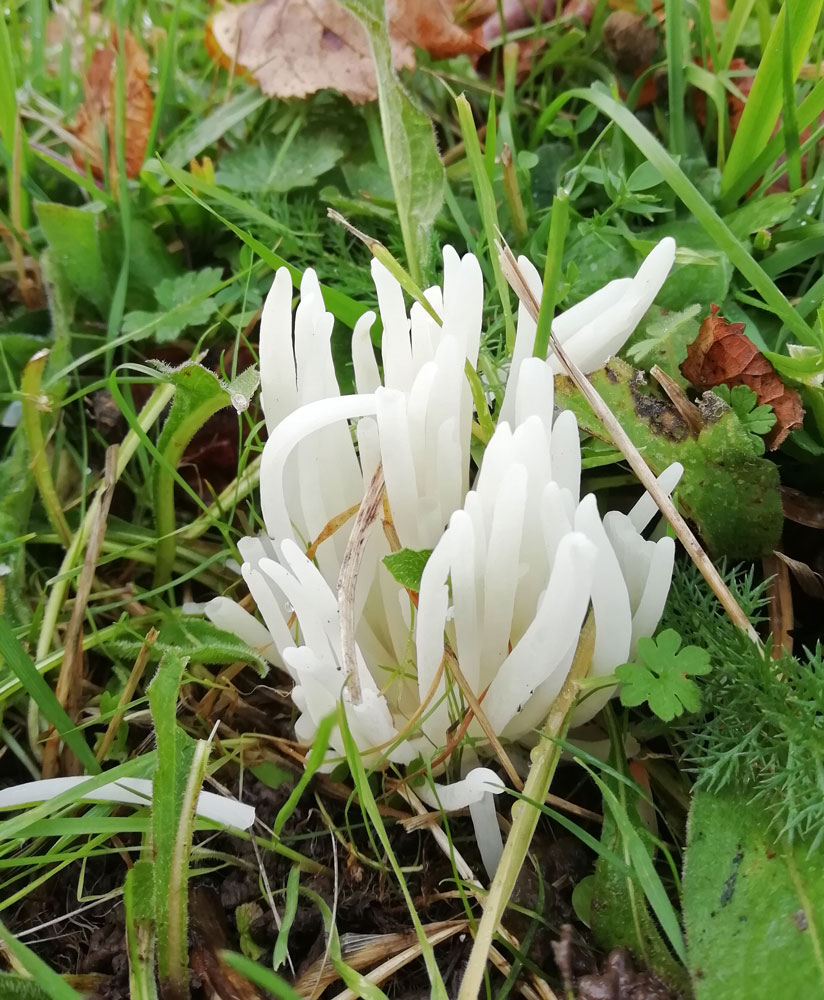
The advice to avoid harrowing seems to arise as a precautionary approach as waxcap fungi seem to be associated with healthy moss growth in grassland. The nature of this association is a complete unsolved scientific mystery, it could just be coincidental that both waxcaps and moss thrive in the same environmental circumstances. Waxcaps do best in short grazed or mown pastures and lawns of low fertility (and zero fertiliser inputs), circumstances where grass is also less dominant and moss can thrive. It makes precautionary sense to not scarify to remove moss from waxcap lawns and pastures.
Moss carpets in meadows are a less constant and often transient phenomena, as the taller meadow vegetation shades the moss out. Moss is very sparse in my meadow, and only really visible at the end of a mild damp winter.
My meadow soil does have a healthy microbiome and as a result I do have waxcaps and other grassland fungi, as well as orchids which depend on soil fungi.
So could I be disrupting these by harrowing?
There appears to be no scientific evidence that surface disturbance from either animal hooves or harrowing has any negative effect on fungal mycelium networks in the soil. Harrowing could of course potentially damage the visible above ground fruiting bodies if done at the wrong time.
In my meadow this autumn I had no visible fungi fruiting at the time I harrowed (late September/first week in October). The ground was perfect for harrowing: moist enough at the surface but still generally dry at depth. The waxcaps (photo above) were stimulated to fruit by the autumn rains, cooler nights and mists that followed, appearing two weeks after I harrowed.
Weeds.
Unfortunately opening up gaps to create opportunities for yellow rattle and other desirable flowers will also create openings that less desirable species could exploit: weeds such as ragwort, hogweed, thistles and creeping buttercup. There is no easy solution to this dilemma. I find that with good follow-on management the type and size of gaps I produce by harrowing does not give rise to an explosion of weeds. A healthy rain of desirable seeds into the gaps, either from the meadow itself, or from added seed will compete for space and help hold weeds back. If I have large gaps (50cm +) I tend to seed these as an insurance, as otherwise I sometimes find creeping buttercup getting in.
Moles.
One of my main reasons for harrowing is to level out mole hills. I have learnt from experience that taking machinery over the meadow to level mole hills when the ground is soft is counterproductive. Even if I do not create visible ruts, mole runs (which are themselves soft spots in the ground), are crushed. What follows is a frenzy of mole activity to repair these damaged runs – result: lots of fresh mole hills!
Harrowing in Autumn whilst the ground is still dry and firm at depth is the answer.
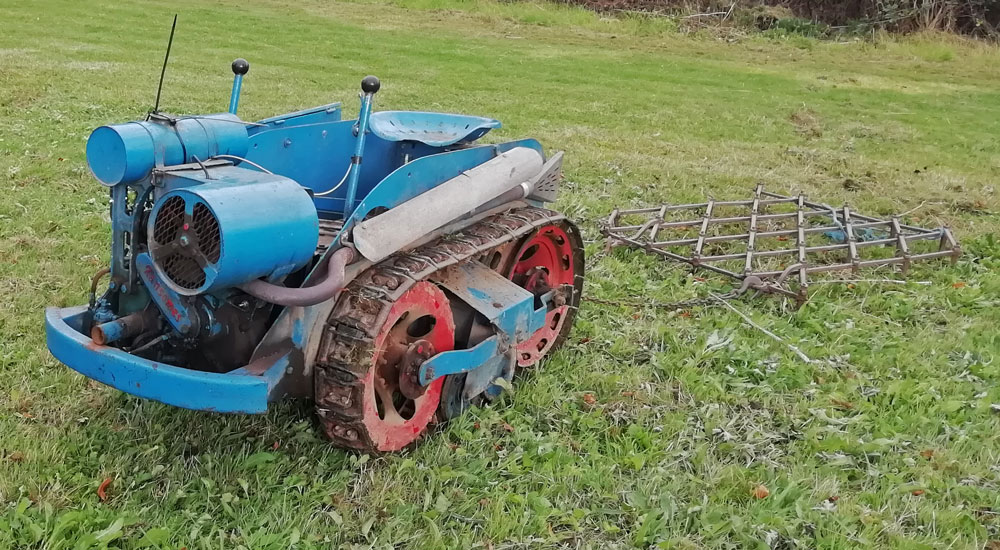
I am also fortunate to own a vintage market garden tractor (a Ransoms MG2 c.1945) with low ground pressure caterpillar tracks. I only had one or two fresh mole hills appear after harrowing using this.
Fascinating. Thanks for such a comprehensive report Richard.
Now I know what to do with the ant hills in my garden!
A very useful article on harrowing that open up the debate and challenges some of the traditional farming activities. Being involved in farming and aspects of habitat creation.
In the 70’s and early 80’s there were many more mixed farmers so grassland was more common. Chain harrowing and rolling were an annual event for grassland and cereals!!!
This was often unnecessary but tradition ran strong. As you say opening up the sward and removing moss were cited as the reasons for these activities but in reality moss generally relates to soil compaction or poor drainage so harrowing will not alleviate this problem. Many farm now sowing new flower meadows have to contend with blackgrass, invasive annual grass, that thrives in disturbed soil so harrowing could potentially encourage the grass weed. You raise a very interesting point relating to type of harrow used. The rigid tine harrow opens up the sward and would be better than chain harrows for reintroducing new flower seed into an existing sward where as chain harrows would do a better job of levelling ant and mole hills and breaking up any dung that had been applied.